


Have you ever paused mid-sentence, unsure whether to write “affect” or “effect”? You’re not alone! These two words often confuse students, writers, and even native English speakers because they sound similar but serve different purposes.
Using them incorrectly can change the meaning of your sentence and make your writing look careless. In this guide, we’ll break down the difference between affect and effect in simple terms, with plenty of examples, tips, and memory tricks to help you remember which is which.
You’ll learn when affect is a verb that shows action and when effect is a noun that points to a result. By the end, you’ll confidently use these words in everyday conversations, professional writing, emails, and exams. Let’s dive in and make this common grammar challenge a thing of the past!
What Does “Affect” Mean?
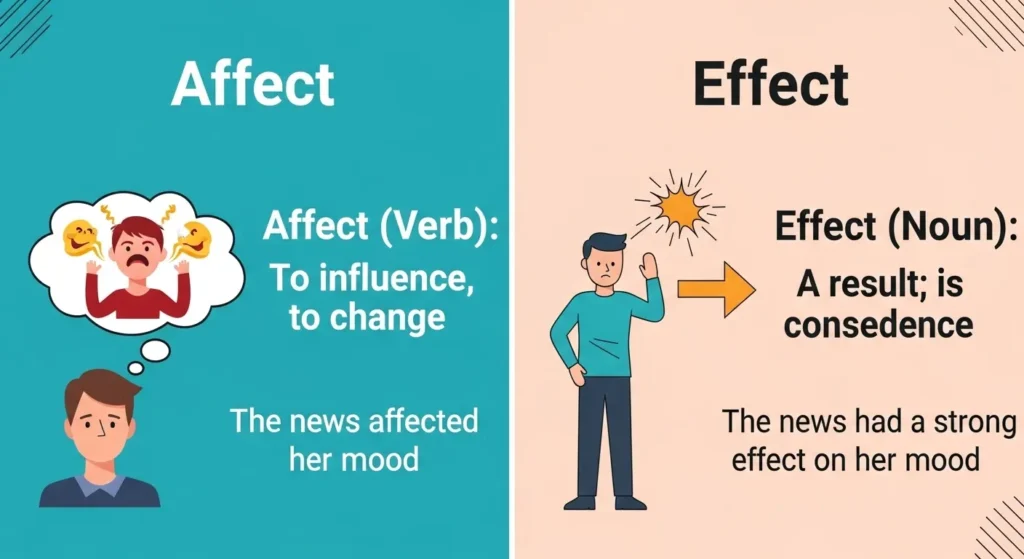
The word “affect” is most commonly used as a verb, meaning to influence or make a change in something. Whenever you want to show that an action has an impact on someone or something, affect is usually the right choice. For example, “The heavy rain affected our travel plans,” shows that the rain had an influence on the plans.
In psychology, affect can also refer to someone’s emotional state, such as: “The patient displayed a flat affect, showing little emotion.”
Here are a few more examples to make it clear:
- “The teacher’s encouragement affected the student’s confidence.”
- “Stress can affect your ability to focus.”
- “Global warming is beginning to affect ecosystems worldwide.”
Quick Tips to Remember “Affect”
- Think of A for Action: Affect = Action = Verb.
- Ask yourself: Is this showing an action or influence? If yes, use affect.
By mastering affect, you can clearly describe how one thing influences or changes another—an essential skill for writing, speaking, and even everyday communication.
What Does “Effect” Mean?
While “affect” is about action, “effect” is usually a noun that refers to the result or outcome of a particular action or event. In other words, when something happens because of a cause, you are usually talking about its effect. For example: “The new study had a positive effect on public awareness,” shows that the study produced a result.
Here are some more examples to clarify:
- “The medicine had an immediate effect on her headache.”
- “The teacher’s guidance had a lasting effect on the students’ learning.”
- “Economic reforms can have a significant effect on employment rates.”
Quick Tips to Remember “Effect”
- Think of E for End result: Effect = End result = Noun.
- Ask yourself: Am I describing the result of an action? If yes, use effect.
Sometimes, effect can also be used as a verb in formal contexts, meaning to bring about or cause: “The new manager will effect changes in the department.” However, this is rare and usually appears in professional or academic writing.
Understanding effect helps you clearly describe outcomes, making your writing precise and professional, whether in essays, reports, or daily conversations.
Key Differences Between Affect and Effect

Although affect and effect sound similar, their roles in a sentence are very different. Confusing them is one of the most common grammar mistakes in English. The simplest way to remember is: affect is usually a verb, and effect is usually a noun.
Here’s a quick comparison:
| Word | Part of Speech | Meaning | Example Sentence |
|---|---|---|---|
| Affect | Verb | To influence or change | The weather can affect your mood. |
| Effect | Noun | The result or outcome | The new law had a positive effect. |
Important Points to Remember:
- Affect = Action: It shows something happening or changing.
- Example: “The news affected her deeply.”
- Effect = Result: It shows the outcome or consequence of an action.
- Example: “The medicine had an immediate effect.”
- Watch out for rare cases: effect as a verb (“to bring about”) and affect as a noun in psychology (“emotional state”).
Quick Tip: If you’re unsure, try substituting the word with “influence”. If it fits, affect is correct. If you can replace it with “result”, then effect is correct.
Mastering this key difference will help you avoid mistakes and write clearly and confidently in all situations.
Affect vs Effect in Everyday English
Understanding affect and effect in theory is one thing, but knowing how to use them in everyday conversations is what really matters. These words appear in emails, casual chats, and daily situations, and using them correctly can make your communication sound polished and professional.
Using Affect in Daily Life:
- “Traffic jams can affect my morning commute.”
- “His mood affected the entire team’s energy.”
- “Skipping breakfast affects your concentration.”
Using Effect in Daily Life:
- “The new exercise routine had a noticeable effect on my stamina.”
- “The surprise gift had a positive effect on her mood.”
- “Regular practice can improve results and show a real effect over time.”
Tips to Spot the Right Word:
- Ask yourself: Is this showing an action or influence? → Use affect.
- Ask yourself: Is this showing a result or outcome? → Use effect.
- Remember common pairs:
- “Affect your health” (action)
- “Effect on your health” (result)
By practicing these examples in emails, messages, and daily speech, you’ll quickly gain confidence and avoid the most common mistakes with affect and effect.
Affect vs Effect in Academic and Professional Writing
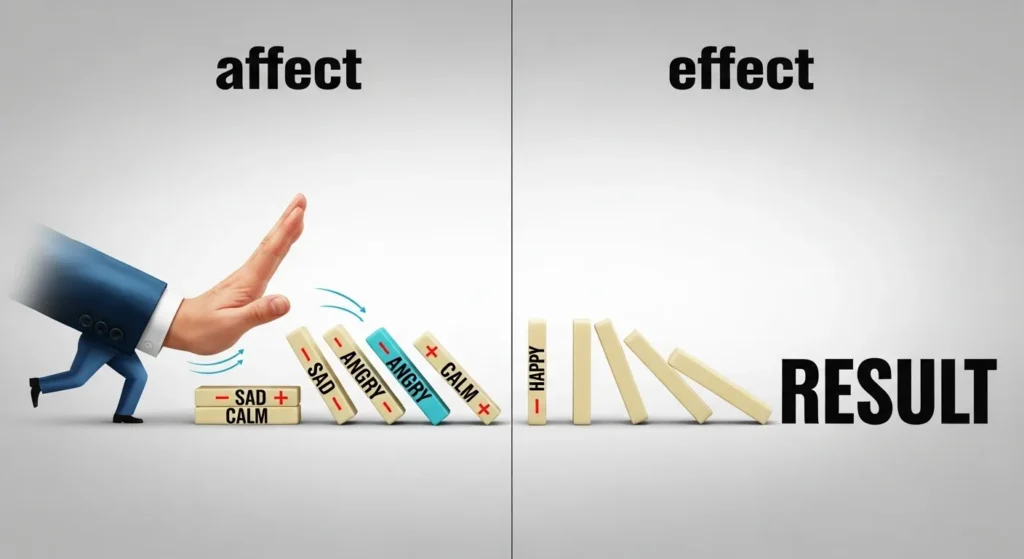
Using affect and effect correctly is especially important in academic papers, reports, and professional writing. Incorrect usage can make your work seem unpolished or even confusing. In formal writing, clarity and precision are key, so distinguishing between action (affect) and result (effect) is crucial.
Affect in Formal Writing:
- “The new curriculum changes affected student performance.”
- “Environmental factors affect the outcome of the experiment.”
- “Changes in policy will affect company procedures.”
Effect in Formal Writing:
- “The reforms had a significant effect on economic growth.”
- “The new software update had a positive effect on productivity.”
- “The intervention’s effect was measured over six months.”
Pro Tips for Professionals:
- Use affect when discussing influences, changes, or actions.
- Use effect when describing results, consequences, or outcomes.
- In formal contexts, avoid using effect as a verb, unless you’re confident in its rare usage: “The CEO will effect major changes.”
By mastering these distinctions, your essays, reports, emails, and presentations will read more professionally, and your audience will clearly understand what caused something (affect) and what resulted (effect).
Common Mistakes and Misconceptions
Even experienced writers sometimes mix up affect and effect, leading to confusing sentences. Understanding common mistakes can help you avoid these errors and write more clearly.
1. Using Effect Instead of Affect (Verb Confusion):
Many people mistakenly use effect as a verb when they should use affect.
- ❌ Wrong: “The news will effect her deeply.”
- ✅ Correct: “The news will affect her deeply.”
2. Using Affect as a Noun (Except in Psychology):
Sometimes learners incorrectly treat affect as a noun in everyday English. This is mostly wrong outside psychology, where it refers to emotional expression.
- ❌ Wrong: “The new policy has a big affect on employees.”
- ✅ Correct: “The new policy has a big effect on employees.”
3. Confusing Cause and Result:
Remember: affect = influence/action, effect = result/outcome. Reversing them changes the meaning.
- ❌ Wrong: “The medicine affected immediate relief.”
- ✅ Correct: “The medicine had an immediate effect.”
Quick Tips to Avoid Mistakes:
- Ask: Am I describing an action or a result?
- Substitute: Influence → affect, Result → effect.
- Practice with sentences and check if they make logical sense.
Recognizing these common errors helps you write with confidence, whether in casual emails, essays, or professional documents.
Advanced Usage and Variations
While most of the time affect is a verb and effect is a noun, English has some advanced or less common uses that are good to know. Understanding these can help you write more formally and understand professional or academic texts.
1. Effect as a Verb:
Although rare, effect can function as a verb meaning to bring about or cause something. This is usually found in formal or legal writing.
- Example: “The new CEO will effect major changes in the company.”
Here, effect is the action of making something happen—different from the usual noun usage.
2. Affect as a Noun (Psychology):
In psychology, affect can be a noun referring to a person’s emotional state or expression.
- Example: “The patient displayed a flat affect, showing little emotion.”
This usage is specialized and not common in everyday English.
3. Idiomatic or Set Phrases:
Some expressions combine affect/effect in ways that may seem tricky:
- “Cause and effect” – highlights a relationship between action and result.
- “Affect positively/negatively” – shows influence in a particular direction.
Knowing these advanced variations ensures you can read academic texts correctly and write in a more sophisticated way, while still avoiding the usual confusion between affect and effect.
Memory Tricks to Remember the Difference
Many learners struggle with affect vs effect because the words sound similar. Using simple memory tricks can help you instantly recall which word to use.
1. Mnemonics:
- Affect → Action → Verb – Remember that affect shows an influence or change.
- Example: “The loud music affected my concentration.”
- Effect → End Result → Noun – Remember that effect is the outcome or result of an action.
- Example: “The new lighting had a positive effect on the room’s atmosphere.”
2. Cause-and-Result Visualization:
Think of it like a chain:
Cause → Affect (action/influence) → Effect (result/outcome).
Visualizing the flow from influence to result helps reinforce correct usage.
3. Substitution Trick:
- Substitute “affect” with “influence”. If it fits, affect is correct.
- Substitute “effect” with “result”. If it fits, effect is correct.
4. Common Pairings:
- “Affect your health” (shows action)
- “Effect on your health” (shows result)
With these memory tricks, you’ll be able to choose the right word confidently, avoid mistakes in emails, essays, and everyday writing, and even explain the difference to others clearly.
Practice Section: Quiz & Exercises
The best way to master affect vs effect is through practice. Here’s a mini quiz and some exercises to test your understanding.
1. Fill in the Blanks:
Choose affect or effect for each sentence:
- The heavy rain will ______ our picnic plans.
- The new policy had a positive ______ on employees’ productivity.
- Her encouragement greatly ______ the student’s confidence.
- The medicine had an immediate ______ on his headache.
- Stress can ______ your sleep patterns.
2. Multiple Choice:
Select the correct word:
- “The CEO’s decision will likely (affect / effect) the company’s strategy.”
- “The new marketing campaign had a significant (affect / effect) on sales.”
3. Answer Key & Explanations:
- affect – shows influence on plans
- effect – result of policy
- affected – influence on confidence
- effect – outcome of medicine
- affect – influence on sleep patterns
- affect – CEO’s action influencing strategy
- effect – campaign’s outcome on sales
Tips for Practice:
- Write your own sentences using affect and effect.
- Substitute “influence” for affect and “result” for effect to check correctness.
- Review mistakes carefully to reinforce memory.
Practicing in this way helps you solidify the difference, ensuring that your writing and speech are accurate and professional.
Conclusion
Mastering the difference between affect and effect is a key step toward clear and professional writing. While these words sound similar, their roles in a sentence are distinct:
affect is usually a verb that shows action or influence, and effect is usually a noun that shows the result or outcome of that action. Keeping this simple distinction in mind can prevent common mistakes in essays, emails, reports, and everyday communication.
Remember the easy tricks:
- Affect → Action → Verb
- Effect → End Result → Noun
- Visualize a chain: Cause → Affect → Effect
- Substitute: Influence → affect, Result → effect
Advanced uses, like effect as a verb or affect as a noun in psychology, are rare but good to know for formal writing or academic contexts.
The key to mastery is practice. Use exercises, quizzes, and real-life examples to reinforce your understanding. Write sentences, review your usage, and check your work with these memory aids.
By applying these tips consistently, you’ll confidently use affect and effect correctly, impress your readers, and communicate ideas with precision. The more you practice, the more natural the distinction will become in your writing and speech.