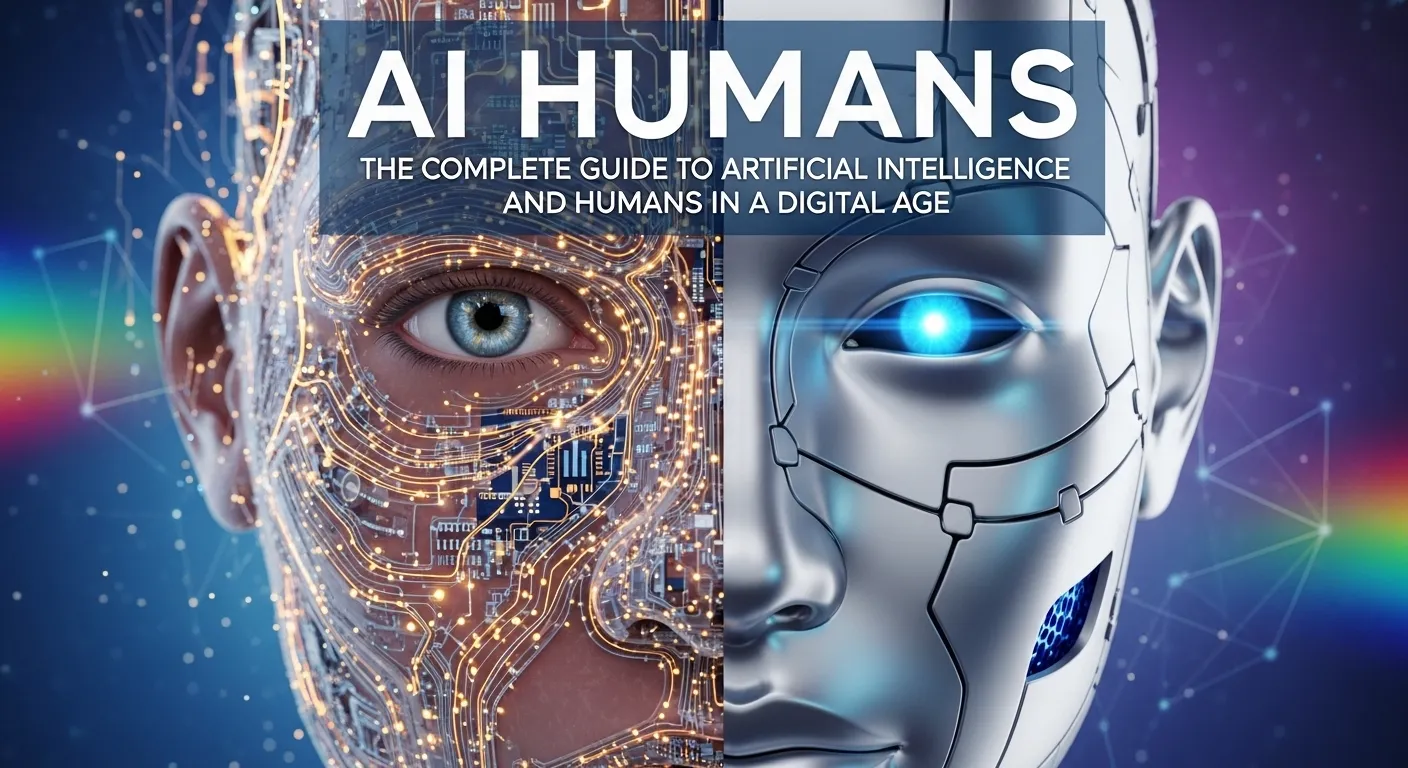

The conversation around AI Humans has moved far beyond science fiction. You see it in virtual assistants that answer your questions. You notice it in recommendation systems that predict what you’ll watch next. And now, you interact with AI-powered humans, digital avatars, and intelligent systems that seem almost alive.
But what does this shift really mean for you?
As AI (Artificial Intelligence) grows smarter and more embedded in daily life, the relationship between Humans and machines becomes more complex. It’s no longer about tools. It’s about partnership. It’s about collaboration. It’s about trust.
This in-depth guide explores everything you need to know about Artificial Intelligence Humans, from Machine Learning and Neural Networks to AI-Human Collaboration, ethics, digital identity, and the future of intelligent virtual beings.
Let’s break it down clearly. No hype. No fluff. Just real insights.
Understanding AI Humans and Artificial Intelligence Humans
The term AI Humans blends two powerful ideas: intelligent machines and human-like behavior. When people search for Artificial Intelligence Humans, they usually mean one of three things:
- AI systems that think or act like humans
- AI-generated digital humans
- Humans working closely with AI
All three are reshaping society.
At its core, Artificial Intelligence refers to computer systems designed to perform tasks that normally require Human Intelligence. These tasks include:
- Learning from data
- Recognizing speech
- Understanding language
- Identifying objects
- Making decisions
AI does this through technologies like:
- Machine Learning
- Deep Learning
- Neural Networks
- Natural Language Processing (NLP)
- Computer Vision
Unlike traditional software, AI doesn’t just follow instructions. It learns patterns. It adapts. It improves over time.
Meanwhile, humans bring something different to the table:
- Cognitive Abilities
- Emotional Intelligence
- Context awareness
- Moral reasoning
- Creativity
The real magic happens when both work together.
AI vs Human Intelligence: What’s the Real Difference?
People often ask, “Is AI smarter than humans?” The answer isn’t simple.
AI can process massive data sets in seconds. Humans can interpret meaning in ambiguous situations. AI excels at repetition. Humans excel at nuance.
Here’s a clear comparison:
| Feature | AI | Humans |
|---|---|---|
| Processing Speed | Extremely high | Moderate |
| Creativity | Pattern-based | Abstract & imaginative |
| Emotional Intelligence | Simulated via Emotional AI | Natural & intuitive |
| Learning Method | Data-driven | Experience & reasoning |
| Ethics & Morality | Programmed | Internalized values |
| Adaptability | Task-specific | Broad & flexible |
AI vs Human Intelligence isn’t a competition. It’s a contrast.
For example, AI in medical imaging can detect patterns in scans faster than a radiologist. However, a doctor interprets those findings within a patient’s life story. That human judgment matters.
That’s why the future isn’t replacement. It’s integration.
How AI Thinks: Machine Learning, Deep Learning, and Neural Networks
To understand Human simulation AI, you need to understand how AI learns.
Machine Learning
Machine learning trains systems using data. Instead of coding every rule, developers feed examples into algorithms.
For example:
- Email spam filters learn from millions of emails.
- Recommendation systems study your behavior.
Deep Learning
Deep learning uses layered neural networks inspired by the human brain. These networks detect patterns across multiple layers.
For instance:
- Speech recognition systems convert voice into text.
- Image recognition identifies faces instantly.
Neural Networks
Neural networks simulate connections between neurons. They process input, adjust weights, and refine outputs over time.
Here’s a simplified structure:
Input Layer → Hidden Layers → Output Layer
The deeper the layers, the more complex the analysis.
This architecture powers:
- Generative AI
- Large Language Models (LLMs)
- Advanced Computer Vision
- AI voice synthesis
And yes, even AI-generated humans.
Human-Like AI and Digital Humans
One of the most fascinating developments is the rise of human-like AI.
These systems simulate appearance, voice, personality, and behavior. They include:
- Digital humans
- Virtual humans
- Synthetic humans
- AI avatars
- Intelligent virtual beings
You’ll find them in:
- Customer service bots
- Virtual influencers
- Online gaming
- The metaverse
- Corporate training simulations
AI Face Generation and Deepfakes
Using deep learning, AI can generate hyper-realistic faces. Some don’t belong to real people. These are entirely synthetic.
This same technology enables Deepfake technology, which can replicate faces and voices convincingly.
That’s powerful. It’s also risky.
Which brings us to ethics.
AI Ethics and Human Responsibility
With great power comes serious responsibility.
AI Ethics addresses issues like:
- Bias in algorithms
- Data privacy
- Surveillance
- Accountability
- Job displacement
Consider this:
If an autonomous vehicle makes a wrong decision, who’s responsible?
Developers? Manufacturers? The AI system itself?
These questions fuel the AI consciousness debate and discussions about AI Alignment. Alignment ensures that AI systems reflect human values.
Key ethical pillars include:
- Transparency
- Fairness
- Accountability
- Privacy
- Safety
Without ethical guardrails, trust collapses.
And without trust, AI fails.
AI-Human Collaboration and Augmented Intelligence
Rather than replacing humans, AI increasingly supports them.
This model is called AI-Human Collaboration or Augmented Intelligence.
Instead of automation taking over, AI enhances human capability.
Examples
- Doctors use AI diagnostics to assist clinical decisions.
- Journalists use AI tools for research support.
- Designers use generative systems for concept sketches.
- Financial analysts use AI for risk modeling.
One powerful concept is Human-in-the-Loop (HITL).
In HITL systems:
- AI generates outputs.
- Humans review, adjust, or approve.
- The system learns from feedback.
This creates continuous improvement.
You stay in control.
Human-Centered AI and Explainable AI (XAI)
AI must serve humans. Not the other way around.
Human-Centered AI focuses on usability, safety, and ethical design.
Meanwhile, Explainable AI (XAI) ensures transparency.
If AI denies someone a loan, you should understand why.
Black-box systems create mistrust. Explainable systems create confidence.
That’s how you build Trust in AI Systems.
Conversational AI, Chatbots, and Virtual Assistants
You likely interact with Conversational AI daily.
Examples include:
- Chatbots
- Virtual assistants
- Customer support AI
- Smart speakers
These systems rely on:
- Natural Language Processing (NLP)
- Sentiment analysis
- Context modeling
- Intent recognition
Modern Large Language Models (LLMs) can generate human-like responses, summarize content, and assist with complex tasks.
They’re not conscious. But they’re increasingly convincing.
That realism improves Human-Computer Interaction (HCI).
Emotional AI and Human Behavior Simulation
Can AI understand feelings?
Not truly. But it can analyze signals.
Emotional AI studies:
- Facial expressions
- Tone of voice
- Word choice
- Behavioral patterns
Using sentiment analysis, systems detect mood and respond accordingly.
For example:
- Customer service bots adjust tone.
- Mental health apps detect stress patterns.
- Marketing systems tailor emotional messaging.
AI also models Human Behavior to predict outcomes. Retailers forecast demand. Streaming services predict viewing habits.
It’s powerful predictive modeling.
But prediction isn’t empathy.
That difference matters.
Robotics and AI-Powered Humans
When AI enters the physical world, robotics takes center stage.
Robotics and automation combine AI decision-making with mechanical systems.
Examples include:
- Warehouse robots
- Surgical robots
- Autonomous drones
- Humanoid robots
These systems rely on:
- Computer Vision
- Real-time processing
- Sensor integration
- Motion planning algorithms
Some humanoid robots now walk, speak, and interact socially.
They blur lines between machine and presence.
AI-Generated Humans, Digital Identity, and the Metaverse
The future includes immersive digital worlds.
In these spaces, you may interact with:
- Metaverse avatars
- AI-generated humans
- Virtual influencers
- Digital companions
These systems use:
- AI personality modeling
- Voice synthesis
- Real-time rendering
- Behavioral simulation
They create persistent digital identities.
However, this raises serious concerns about:
- Authenticity
- Deepfake misuse
- Digital impersonation
- Ownership of likeness
Identity in the AI era becomes fluid.
You must protect it carefully.
The AI Consciousness Debate
Can AI become conscious?
Some argue that advanced Cognitive computing and complex neural architectures could lead to machine awareness.
Others insist AI simply mimics patterns.
Current systems lack:
- Self-awareness
- Intent
- Emotional depth
- Independent moral reasoning
They simulate. They don’t experience.
Still, the debate continues in philosophy, neuroscience, and computer science.
It’s one of the most profound questions of our time.
AI Companionship and Social Interaction
AI now plays a role in companionship.
Some users interact with AI for:
- Emotional support
- Practice conversations
- Language learning
- Loneliness relief
AI companionship raises both hope and concern.
Benefits:
- Accessibility
- Non-judgmental interaction
- 24/7 availability
Risks:
- Emotional dependence
- Reduced human contact
- Manipulative design
Balance matters.
Technology should enhance social interaction. Not replace it.
Future Trends in AI Humans and Artificial Intelligence Humans
The next decade will accelerate change.
Expect to see:
- More advanced Generative AI
- Smarter LLMs
- Improved Human-AI collaboration
- Stronger AI Ethics regulation
- Increased personalization
- Seamless multimodal AI systems
Governments and research institutions are already drafting policies. For example, the U.S. National AI Initiative outlines strategic priorities:
https://www.ai.gov/
Meanwhile, research institutions like MIT’s CSAIL explore frontier AI developments:
https://www.csail.mit.edu/
Innovation won’t slow down.
But human oversight will define outcomes.
Key Facts About AI and Humans Today
Here are clear, up-to-date realities:
- AI contributes trillions to the global economy annually.
- Machine learning drives most modern recommendation systems.
- Deep learning powers advanced speech and image recognition.
- Robotics adoption continues rising in logistics and healthcare.
- AI ethics frameworks now guide major tech companies.
The relationship between AI and Humans grows deeper every year.
Final Thoughts
AI Humans are at the frontier of technology, offering a glimpse into a future where human-like machines interact Seamlessly with society.
They promise efficiency, companionship, and innovation but also require careful ethical oversight. As AI Humans evolve, striking a balance between progress and responsibility will ensure.
they remain a force for good, transforming our world without replacing the very essence of human connection.