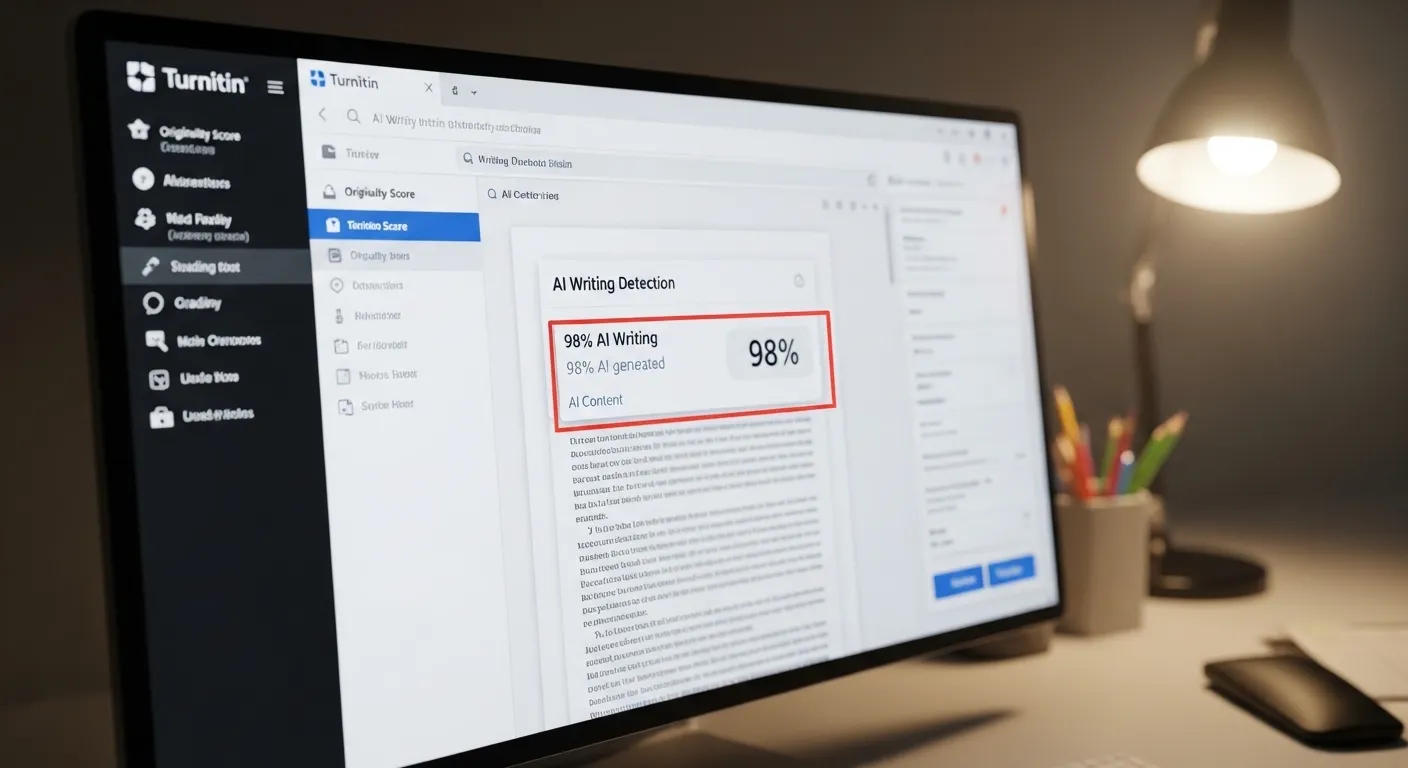

Artificial intelligence has transformed how people write. Tools powered by Artificial Intelligence, Machine Learning, and Natural Language Processing can now produce essays, reports, and articles within seconds.
That convenience has sparked an important question across schools and universities: Can academic institutions detect AI-generated writing?
That’s where Turnitin enters the conversation. Known worldwide for its plagiarism detection software, Turnitin now offers advanced AI content detection capabilities designed to identify AI writing and protect Academic Integrity.
In this detailed guide, you’ll learn how Turnitin AI writing detection works, how accurate the Turnitin AI detector really is, and what both students and teachers should understand about the system.
Along the way, we’ll break down the Turnitin AI detection algorithm, examine real detection reports, and explain the difference between AI plagiarism detection and traditional similarity checks.
Let’s dig into the technology that’s reshaping academic writing.
What Is Turnitin AI Writing Detection?
Turnitin AI writing detection is a specialized AI detection software feature built into the Turnitin platform. It analyzes submitted documents and estimates how much text may have been generated using Artificial Intelligence writing tools.
Unlike basic plagiarism checks that compare content against databases, the Turnitin AI detector evaluates writing patterns. It looks for signals often found in AI generated text detection, including predictable phrasing, uniform sentence structure, and unusual linguistic probability patterns.
Core functions of the Turnitin AI detection tool
- Identify potential AI generated essay detection
- Provide a Turnitin AI detection percentage
- Generate a Turnitin AI detection report
- Assist teachers with AI detection tools for teachers
- Support universities with academic integrity tools
This system is built to detect AI-generated text produced by tools like ChatGPT, Jasper, and other AI text generation platforms.
Why universities rely on it
Academic institutions rely on Turnitin AI content detection because it supports three essential goals:
- Protecting academic integrity
- Ensuring authentic student work
- Preventing automated writing abuse
In short, Turnitin doesn’t just ask “Was this copied?”
It asks a more modern question: “Was this written by a human?”
How Turnitin Detects AI Writing
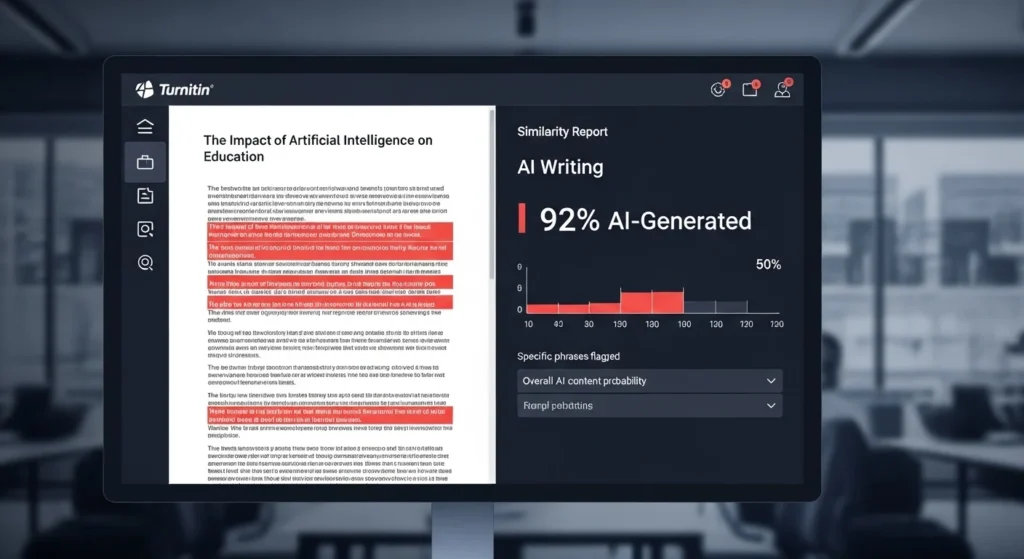
Understanding how Turnitin detects AI writing requires a look at the technology behind machine learning text detection.
Turnitin’s system uses advanced AI text classifier models trained on millions of examples of both human writing and AI generated text.
The Turnitin AI detection algorithm
The algorithm examines several linguistic patterns:
| Detection Factor | What It Measures | Why It Matters |
|---|---|---|
| Predictability | How statistically predictable words are | AI text often follows highly probable patterns |
| Burstiness | Variation in sentence length | Humans vary rhythm more than AI |
| Perplexity | Complexity of phrasing | AI tends to generate smoother but simpler phrasing |
| Structure | Paragraph and grammar patterns | AI writing often follows uniform patterns |
| Semantic flow | Topic continuity | AI may produce slightly unnatural transitions |
These patterns allow the Turnitin AI detection system to estimate whether content came from an AI model.
The detection process step-by-step
Submission
A student uploads an essay or assignment.
Text analysis
The Turnitin AI writing detector scans the text using Natural Language Processing.
Pattern comparison
The system compares the writing to known AI generated text patterns.
Probability score
It estimates the Turnitin AI detection percentage.
Report generation
Teachers receive a Turnitin AI writing analysis report.
Turnitin AI Detection vs Plagiarism Checker
Many people confuse AI detection with traditional plagiarism detection. They work differently.
| Feature | Plagiarism Detection | AI Writing Detection |
|---|---|---|
| Purpose | Find copied content | Detect AI-generated text |
| Method | Database comparison | Machine learning pattern analysis |
| Output | Similarity percentage | AI probability percentage |
| Example result | 25% similarity | 60% AI probability |
Key differences
Turnitin AI plagiarism detection
Checks whether text matches existing sources online or in academic databases.
Turnitin AI content detection
Identifies automated writing detection patterns that resemble AI-generated content.
Because of this difference, a document may show:
- 0% plagiarism
- but 80% AI detection score
That means the text appears original yet still resembles AI generated writing.
Does Turnitin Detect ChatGPT Content?
A common question students ask is:
Does Turnitin detect ChatGPT content?
The answer is sometimes yes.
The Turnitin AI detection technology is specifically trained to recognize writing patterns common in AI models like ChatGPT.
However, detection is probabilistic, not absolute.
Why AI detection is possible
AI writing often contains recognizable traits:
- Highly balanced sentence structures
- Smooth logical flow
- Low linguistic unpredictability
- Repetitive phrasing patterns
These characteristics make AI generated text detection Turnitin possible.
When detection becomes harder
Detection may be less accurate when:
- AI text is heavily edited by humans
- Personal experiences are added
- Sentence structures vary significantly
- Writing style becomes unpredictable
Even then, Turnitin AI text detection tools still analyze probability patterns.
Turnitin AI Detection Percentage Explained
The Turnitin AI detection percentage is one of the most misunderstood parts of the system.
This score estimates the likelihood that content was generated using AI.
Example interpretation table
| AI Detection Score | Meaning |
|---|---|
| 0–10% | Likely human writing |
| 10–40% | Possible AI influence |
| 40–70% | Strong AI patterns |
| 70–100% | Highly likely AI generated |
Teachers often use this score as a signal, not final proof.
Important fact
Turnitin itself states that AI detection should not be used as the sole evidence of misconduct. It should be part of a broader academic integrity investigation.
How Accurate Is Turnitin AI Detection? (2026 Data)
One of the most searched questions online is:
How accurate is Turnitin AI detection 2026?
According to Turnitin’s published research, the Turnitin AI checker accuracy is designed to maintain a very low false-positive rate.
Official performance statistics
| Metric | Approximate Value |
|---|---|
| False positive rate | <1% |
| AI detection accuracy | ~98% pattern confidence |
| Human text misclassification | Extremely rare |
However, several external researchers note that AI detection software is still evolving.
Why accuracy varies
Factors that influence Turnitin AI detection accuracy include:
- Writing complexity
- Editing by humans
- Paraphrasing tools
- Mixed AI + human content
- Prompt engineering techniques
Because of these factors, AI detection tools for teachers should always be interpreted carefully.
Turnitin AI Detection Report: What Teachers See
When a document is submitted, instructors receive a Turnitin AI detection report alongside the traditional similarity report.
The report usually includes
- AI detection score
- Highlighted AI-suspected sections
- Turnitin AI similarity report
- Text classification results
Example report structure
| Section | Description |
|---|---|
| AI Writing Percentage | Estimated AI-generated content |
| Highlighted Text | Possible AI-written passages |
| Similarity Index | Traditional plagiarism score |
| Source Matching | External references found |
This report helps educators understand Turnitin AI vs human writing detection patterns.
Turnitin AI Detection for Students
Students often worry about how Turnitin AI detection for students works and whether legitimate work might be flagged.
Understanding the system helps reduce anxiety.
Key things students should know
- AI detection shows probability, not certainty
- Teachers usually review flagged text manually
- Personal writing style lowers AI detection risk
- Citations and sources still matter
Common student questions
Can Turnitin detect AI generated content?
Yes. It can estimate probability using AI text classification models.
Does editing AI text avoid detection?
Editing helps but does not guarantee invisibility.
Is there a Turnitin AI checker free version?
No public version exists. Universities provide access.
Turnitin AI Detection for Teachers
For educators, Turnitin AI detection for teachers serves as a monitoring tool rather than a final judge.
Teachers can review suspicious content and decide whether to investigate further.
Benefits for instructors
- Supports content authenticity verification
- Helps identify AI generated essay detection
- Saves time reviewing suspicious submissions
- Reinforces academic integrity policies
Recommended workflow
Teachers often follow this process:
- Review AI detection percentage
- Examine highlighted sections
- Compare with student’s previous writing
- Ask the student about their process
- Decide if further review is needed
This balanced approach reduces false accusations.
Turnitin AI Detection Technology Explained
The technology behind Turnitin AI detection system combines several advanced fields.
Core technologies involved
- Artificial Intelligence
- Machine Learning
- Natural Language Processing
- Text Classification
- Statistical Linguistics
These systems analyze language probability models trained on both human and AI writing samples.
Simplified diagram of the system
Student Essay
      ↓
Text Processing
      ↓
AI Pattern Analysis
      ↓
Machine Learning Model
      ↓
AI Probability Score
      ↓
Detection Report
This pipeline forms the backbone of automated writing detection.
Best AI Detection Tools Similar to Turnitin
Although Turnitin AI checker dominates the academic world, several other AI text detection tools exist.
Popular alternatives
| Tool | Purpose |
|---|---|
| GPTZero | AI writing detector for students |
| Originality.ai | AI content checker for SEO |
| Copyleaks AI Detector | AI plagiarism detection |
| Writer AI Detector | Content authenticity analysis |
These tools provide additional AI content originality check capabilities.
However, Turnitin AI detection tool for universities remains the most widely used academic system.
How to Avoid Turnitin AI Detection (Ethically)
Students often search how to avoid Turnitin AI detection. The safest approach is simple:
Write your own work.
However, AI can still assist ethically if used properly.
Ethical ways to use AI
- Brainstorm ideas
- Create outlines
- Generate topic suggestions
- Improve grammar
What students should avoid
- Submitting raw AI-generated essays
- Using paraphrasing tools to hide AI
- Copy-pasting full AI responses
These practices risk triggering Turnitin AI content flagging.
Turnitin AI Detection Update: Future of AI Content Monitoring
The Turnitin AI detection update cycle continues to evolve.
As AI models become more advanced, detection systems must adapt.
Expected improvements by 2026-2027
- Better AI generated text detection
- Improved machine learning text detection
- Lower false positives
- Detection of hybrid human-AI writing
Experts predict AI detection tools for teachers will become standard in education worldwide.
Key Facts About Turnitin AI Writing Detection
Here are several quick facts about the system.
| Fact | Detail |
|---|---|
| Platform | Turnitin |
| Purpose | Detect AI-generated writing |
| Detection method | Machine learning pattern analysis |
| Output | AI probability percentage |
| Primary users | Universities and teachers |
Important takeaway
AI detection tools support Academic Integrity, but they cannot replace human judgment.
Conclusion
The rise of AI writing has fundamentally changed the academic landscape. Essays that once required hours of research can now appear instantly through AI systems. Because of this shift, universities rely on advanced solutions like Turnitin AI writing detection to maintain fairness and authenticity.
The Turnitin AI detector works by analyzing writing patterns using Machine Learning, Natural Language Processing, and sophisticated text classification algorithms. Instead of searching for copied text alone, the system evaluates probability signals that indicate AI generated text detection.
Still, it’s important to understand the limits. A Turnitin AI detection score reflects probability rather than absolute proof. Teachers must interpret reports carefully and combine them with professional judgment.
For students, the best strategy remains simple: write original work, use AI responsibly, and treat technology as a helper rather than a shortcut.
As AI continues to evolve, so will AI detection software. The goal is not to punish technology use but to protect the values that education depends on — authentic learning, honest work, and true intellectual growth.