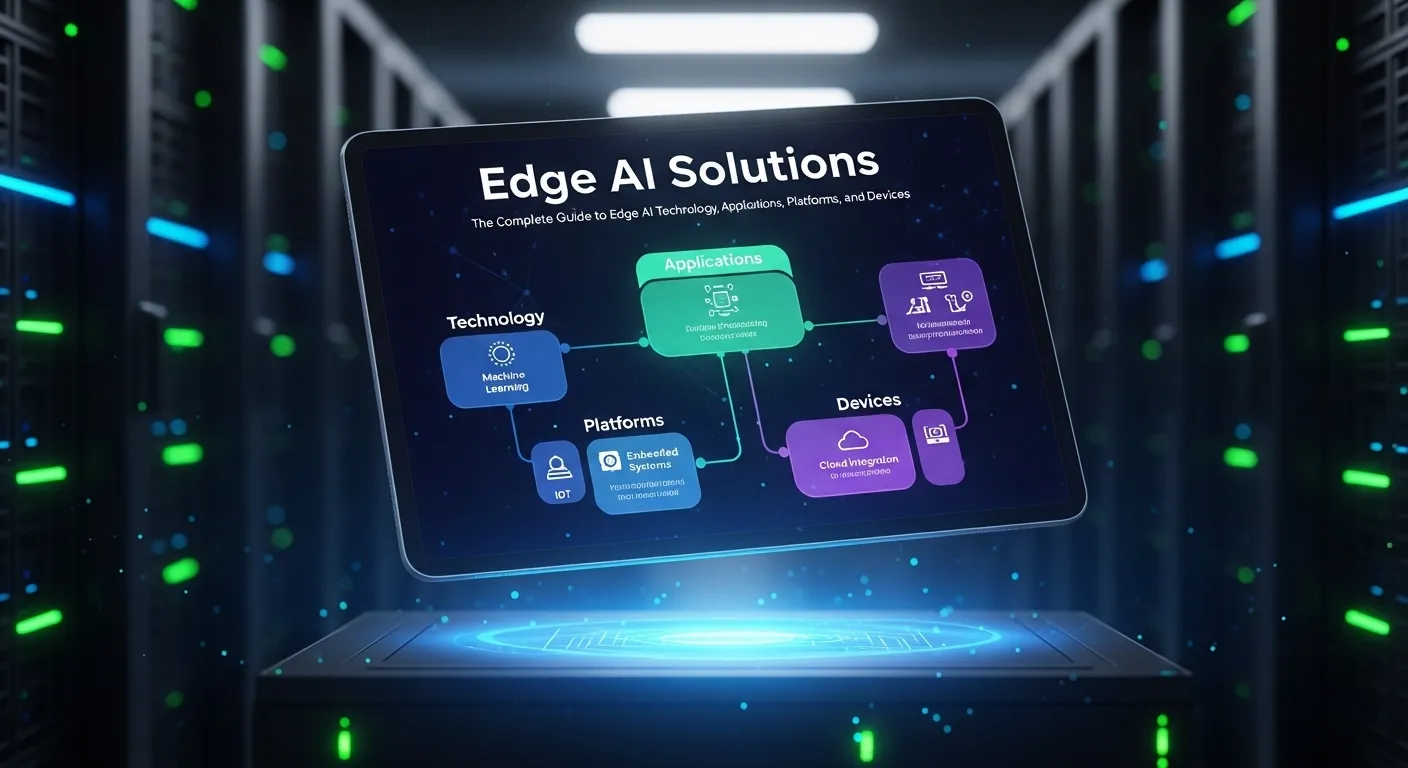

The world of Artificial Intelligence is changing faster than ever. Businesses no longer rely only on cloud computing to process massive amounts of data. Instead, they are shifting toward Edge AI solutions, where intelligence happens directly on devices close to where the data is created.
Imagine a factory machine that detects a defect instantly. Or a smart camera that identifies suspicious activity without sending video to the cloud. That’s the power of AI at the edge.
This guide explores everything you need to know about edge ai technology, including platforms, devices, real-world applications, infrastructure, and business benefits. By the end, you’ll understand why organizations across industries are investing heavily in edge computing AI solutions.
Understanding Edge AI Solutions
Edge AI solutions combine Edge Computing and Artificial Intelligence Technology to process data locally rather than sending it to centralized servers.
Traditional AI systems collect data and send it to the cloud for analysis. However, Edge AI moves Machine Learning and Deep Learning models directly onto devices.
This approach creates faster responses and reduces network dependency.
What Is Edge AI?
Edge AI refers to running AI Systems directly on devices such as:
- Cameras
- Sensors
- Smartphones
- Industrial machines
- Autonomous robots
These systems perform model inference locally using optimized Edge AI models.
Key Characteristics of Edge AI
| Feature | Description |
|---|---|
| Low-latency computing | Decisions happen instantly on-device |
| Real-time data processing | Data is analyzed immediately |
| Distributed computing | Processing occurs across many devices |
| Improved privacy | Sensitive data stays local |
| Reduced bandwidth | Less data sent to the cloud |
Instead of sending massive video streams or sensor readings to remote servers, edge intelligence processes everything close to the data source.
How Edge AI Technology Works
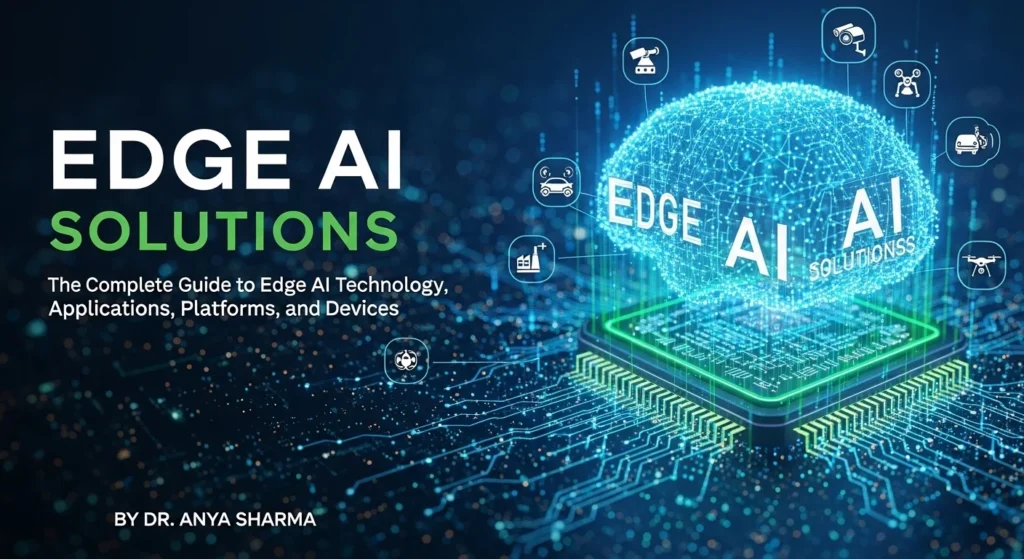
To understand edge ai technology, it helps to look at how the architecture functions.
Basic Edge AI Architecture
Data Source → Edge Device → Edge AI Model → Decision → Optional Cloud Sync
Data comes from IoT devices, cameras, or sensors.
Then Edge AI frameworks run Machine Learning at the edge to generate insights.
Core Components of Edge AI Systems
Edge AI systems rely on several layers of technology.
Hardware Layer
- Edge AI chips
- Neural processing units (NPUs)
- Tensor processing units (TPUs)
- Embedded processors
Software Layer
- Edge AI software
- AI Software Solutions
- Edge AI frameworks
- Model optimization tools
Infrastructure Layer
- Edge Computing Infrastructure
- Network connectivity
- Cloud integration
- Security systems
Real Example
A smart traffic camera in a smart city performs computer vision at the edge.
The system detects vehicles, traffic density, and violations instantly.
Only summary data goes to the cloud. Video stays local.
Why Businesses Are Adopting Edge AI Solutions
Organizations across industries now rely on enterprise edge AI solutions to improve efficiency and automation.
Major Benefits of Edge AI
Instant decision-making
Real-time processing enables low latency AI responses.
Improved privacy
Sensitive data remains on edge AI devices rather than traveling through networks.
Lower operational costs
Less cloud processing reduces bandwidth and storage expenses.
Scalable AI deployment
Companies can deploy thousands of devices simultaneously.
Edge AI vs Cloud AI
| Feature | Cloud AI | Edge AI |
|---|---|---|
| Data processing | Centralized | Local |
| Latency | Higher | Very low |
| Internet dependency | Required | Optional |
| Data privacy | Lower | Higher |
| Scalability | High | High |
This is why many organizations now combine both approaches in hybrid AI deployment models.
Edge AI Platforms Powering Modern Applications
A powerful edge ai platform allows developers to build and deploy AI Applications directly on edge devices.
These platforms provide tools for model training, optimization, and AI deployment.
Popular Edge AI Platforms
Some of the most widely used platforms include:
| Platform | Primary Use |
|---|---|
| NVIDIA Jetson | Robotics and vision AI |
| Google Coral | TPU-based edge inference |
| Intel OpenVINO | Edge vision optimization |
| AWS IoT Greengrass | Cloud-connected edge computing ai solutions |
| Azure IoT Edge | Enterprise AI deployment |
These Edge AI platforms simplify development and allow businesses to implement AI-powered edge devices quickly.
Capabilities of Edge AI Platforms
- Deploy Deep Learning models on small devices
- Manage distributed AI systems
- Enable real-time AI processing
- Monitor device performance
- Secure edge AI infrastructure
Edge AI Devices Transforming Smart Technology
Edge AI devices represent the physical layer of intelligent computing.
These devices integrate AI chips, sensors, and optimized software to analyze data locally.
Types of Edge AI Devices
Consumer devices
- Smartphones
- Smart speakers
- Home security cameras
Industrial devices
- Factory robots
- Quality inspection cameras
- Industrial sensors
Healthcare devices
- Medical imaging scanners
- Remote patient monitoring devices
- Wearable health trackers
Examples of AI-Powered Edge Devices
| Device | AI Function |
|---|---|
| Smart cameras | Object detection |
| Autonomous drones | Navigation |
| Industrial robots | Precision automation |
| Retail cameras | Customer behavior analysis |
These devices combine Embedded AI systems with advanced hardware like NPUs.
Edge AI Applications Across Industries
The real power of edge ai applications appears when industries adopt them for real-world use cases.
Manufacturing and Industrial Automation
Factories use edge ai solutions for manufacturing to monitor machines and predict failures.
Smart sensors collect vibration and temperature data.
Then predictive analytics detects anomalies.
Benefits include:
- Reduced downtime
- Higher productivity
- Predictive maintenance
This is a cornerstone of Industrial automation.
Healthcare and Medical Devices
Healthcare organizations rely on edge ai solutions for healthcare for faster diagnostics.
Examples include:
- Portable ultrasound systems
- AI-assisted medical imaging
- Patient monitoring devices
Healthcare AI devices process data locally which ensures patient privacy and immediate alerts.
Retail Analytics
Retailers deploy edge ai solutions for retail analytics to understand customer behavior.
Smart cameras perform computer vision at the edge to analyze:
- Customer traffic
- Product interactions
- Checkout wait times
Retail managers receive actionable insights instantly.
Smart Cities and Urban Infrastructure
City planners rely on edge ai solutions for smart cities to improve public services.
Applications include:
- Traffic monitoring
- Waste management
- Public safety surveillance
- Energy optimization
Smart sensors combined with IoT edge computing enable responsive urban systems.
Security and Surveillance
Security companies use edge ai solutions for security systems for real-time threat detection.
Smart cameras identify suspicious activity instantly without sending raw footage to servers.
This allows faster incident response.
Edge AI Solutions for IoT Ecosystems
The Internet of Things (IoT) produces enormous amounts of data.
Sending everything to the cloud becomes inefficient.
That’s where edge ai solutions for IoT come in.
Why Edge AI Is Critical for IoT
IoT networks often include thousands of sensors. Processing data locally ensures efficiency.
Key benefits:
- Reduced bandwidth usage
- Faster responses
- Greater reliability
Edge AI in Smart Sensors
Smart sensors now include built-in Machine Learning capabilities.
Examples include:
| Sensor Type | Edge AI Capability |
|---|---|
| Temperature sensors | Predict machine failure |
| Cameras | Detect motion |
| Environmental sensors | Analyze pollution patterns |
These sensors represent the future of smart edge technology.
Real-Time Edge AI Solutions for Automation
Automation systems require immediate decision-making.
Real-time edge ai solutions enable machines to react instantly without waiting for cloud responses.
Applications in Autonomous Systems
Autonomous vehicles and drones rely on AI at the edge.
They process data from cameras, radar, and lidar using edge AI processing.
Without local processing, safe navigation would be impossible.
Robotics and Smart Manufacturing
Modern Robotics systems combine Deep Learning with edge computing.
Robots analyze images and adjust movements instantly.
Benefits include:
- Faster production lines
- Improved precision
- Reduced human error
Technical Components of Edge AI Hardware
Behind every edge ai system lies powerful specialized hardware.
Edge AI Chips
These chips accelerate model inference directly on devices.
Common examples include:
- GPU-based accelerators
- Neural processing units (NPUs)
- Tensor processing units (TPUs)
Edge AI Hardware Stack
| Layer | Hardware Example |
|---|---|
| Sensors | Cameras, microphones |
| Processing | NPUs, GPUs |
| Memory | High-speed embedded memory |
| Connectivity | Wi-Fi, 5G, Ethernet |
These components enable low-latency computing in AI edge devices.
Edge AI Software and Frameworks
Hardware alone isn’t enough. Edge AI software enables intelligent functionality.
Popular Edge AI Frameworks
Developers rely on specialized frameworks to deploy models efficiently.
Common tools include:
- TensorFlow Lite
- PyTorch Mobile
- ONNX Runtime
- OpenVINO
These frameworks optimize edge AI models for on-device AI processing.
Key Software Capabilities
Edge AI frameworks support:
- Edge inference
- Model compression
- Hardware acceleration
- Distributed deployment
They ensure that AI model deployment at edge remains efficient even on low-power devices.
Edge AI Deployment Strategies
Organizations must carefully plan edge ai deployment to ensure scalability.
Common Deployment Models
| Deployment Type | Description |
|---|---|
| Device-level AI | Models run on individual devices |
| Gateway AI | Processing occurs on local gateways |
| Hybrid edge-cloud | Edge processing with cloud backup |
Most companies adopt hybrid edge AI architecture.
Best Practices for Deployment
Successful scalable edge ai solutions require:
- Efficient model optimization
- Secure device management
- Continuous monitoring
- Over-the-air updates
These practices help maintain reliable AI Systems.
Best Edge AI Solutions for Businesses
Businesses looking for best edge ai solutions for businesses often evaluate providers based on scalability and performance.
Leading Enterprise Edge AI Providers
Several companies dominate the market:
| Company | Edge AI Offering |
|---|---|
| NVIDIA | Edge AI hardware and platforms |
| Intel | AI acceleration chips |
| Coral Edge TPU devices | |
| Microsoft | Azure Edge AI services |
| Amazon | AWS edge AI infrastructure |
These organizations provide full edge ai services including hardware, software, and analytics tools.
Future Trends in Edge AI Technology
The future of edge ai technology looks incredibly promising.
Emerging Innovations
Several trends will define the next decade.
Smaller AI chips
Advanced Edge AI chips will deliver higher performance with lower power consumption.
5G connectivity
Ultra-fast networks will enhance edge computing ai solutions.
Federated learning
Devices will train AI models collaboratively without sharing raw data.
Autonomous infrastructure
Smart systems will manage cities, factories, and logistics automatically.
Market Growth
Industry analysts predict massive expansion.
| Year | Estimated Market Size |
|---|---|
| 2023 | $15 Billion |
| 2025 | $40 Billion |
| 2030 | $150 Billion |
This rapid growth reflects increasing demand for intelligent edge systems.
Cloud vs Edge AI: Finding the Right Balance
Many businesses wonder whether to choose cloud AI or artificial intelligence at the edge.
The best strategy often combines both.
When Cloud AI Works Best
Cloud processing suits tasks that require:
- Massive datasets
- Long-term model training
- Heavy computing workloads
When Edge AI Excels
Edge AI is ideal for:
- Real-time decisions
- Remote environments
- Privacy-sensitive applications
A hybrid approach balances both technologies.
Final Thoughts
The rise of edge ai solutions marks a fundamental shift in how Artificial Intelligence Technology operates.
Instead of relying solely on centralized servers, intelligence now spreads across networks of AI-powered edge devices.
This shift unlocks new possibilities:
- Smarter IoT devices
- Autonomous systems
- Intelligent cities
- Real-time industrial automation
As Edge AI platforms, Hardware, and frameworks continue evolving, organizations will deploy more AI applications directly at the data source.
Businesses that invest early in edge computing ai solutions will gain faster insights, stronger automation, and significant competitive advantages.
Discover More Post
- AI Pokémon: The Ultimate Guide to Artificial Intelligence Pokémon Creations
- Best AI Image Generator No Sign Up: How to Create AI Images Without Login (2026 )
- 🌙 Dream Journey AI: Exploring the Future of Dreams Through Artificial Intelligence 🤖