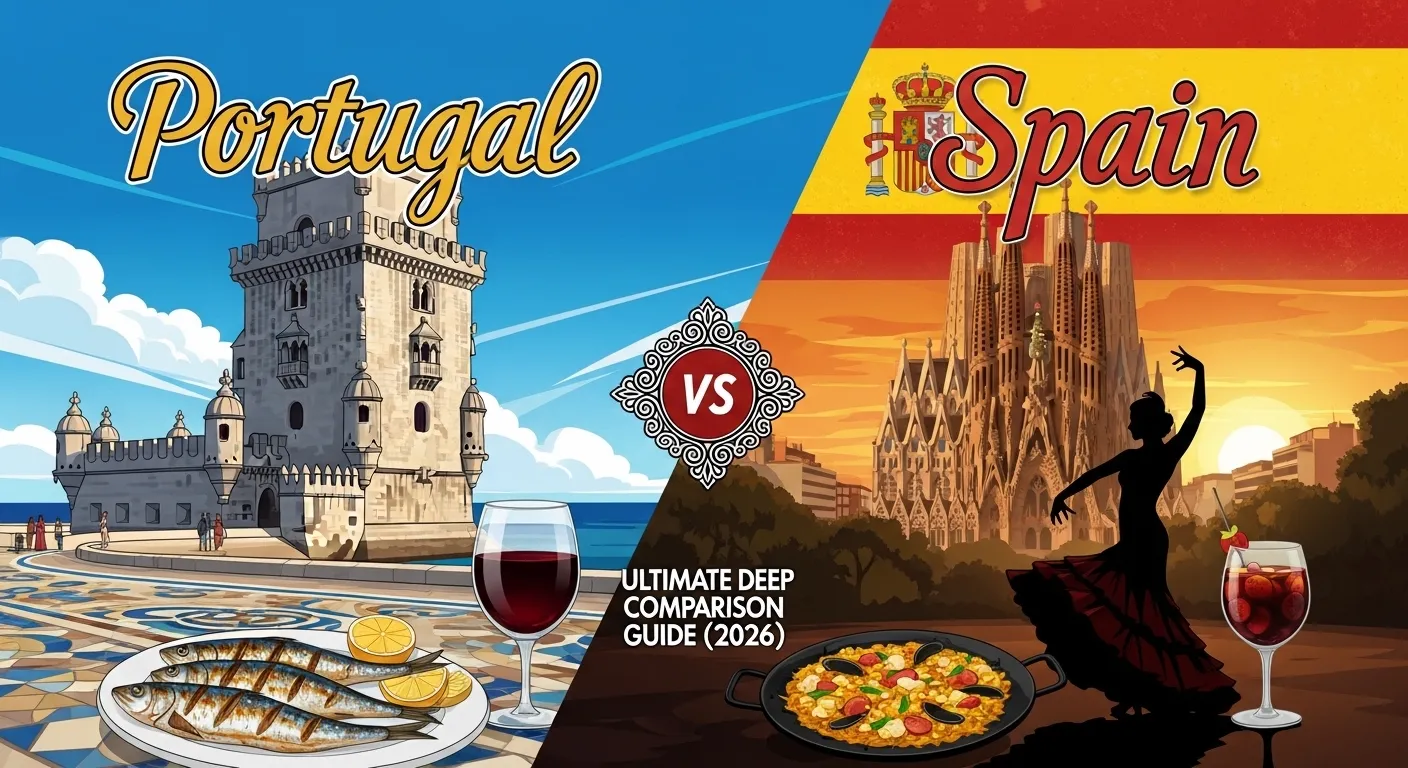

Portugal and Spain are two of the most beautiful and culturally rich countries in Europe, located side by side on the Iberian Peninsula.
Although they share borders, sunshine, and a long historical connection, both nations offer completely different experiences for travelers, expats, and digital nomads.
From stunning beaches and vibrant cities to unique cuisines and deep-rooted traditions, choosing between Portugal and Spain can be surprisingly difficult.
Spain is known for its energetic lifestyle, famous cities like Barcelona and Madrid, and diverse regional cultures.
On the other hand, Portugal offers a more relaxed atmosphere, charming coastal towns, and a slower pace of life that attracts many visitors seeking peace and affordability.
In this guide, we will compare Portugal vs Spain in detail, covering cost of living, tourism, food, safety, lifestyle, and more. By the end, you’ll have a clear idea of which destination suits your travel or living goals best.
🌍 Geographic Overview, Climate & Natural Setting (Portugal vs Spain)
Portugal and Spain are neighboring countries on the Iberian Peninsula in southwestern Europe, but their geography and natural environments create noticeably different experiences for visitors and residents.
Spain is significantly larger and more geographically diverse. It features mountain ranges like the Pyrenees in the north and Sierra Nevada in the south, vast plateaus in central regions, and two major island groups—the Balearic Islands in the Mediterranean and the Canary Islands in the Atlantic Ocean. This diversity gives Spain a wide range of climates, from snowy winters in the north to hot, dry summers in the south. Because of this, Spain is ideal for travelers who want variety in landscapes and weather within a single country.
Portugal, in contrast, is smaller and more compact, with a long Atlantic coastline that defines much of its identity. The country is famous for its dramatic cliffs in the Algarve, golden beaches, and rolling inland hills. Portugal’s climate is more consistent, with mild winters and warm summers influenced by the Atlantic Ocean, making it a comfortable destination year-round.
In terms of nature, Spain offers more dramatic contrasts and large-scale landscapes, while Portugal provides a more peaceful, coastal-focused environment. Both countries are rich in natural beauty, but the experience they offer depends on whether you prefer variety and adventure or calm and scenic coastal living.
🏛️ History, Culture & Heritage Comparison (Portugal vs Spain)
Spain and Portugal both have deep historical roots that shaped not only Europe but also parts of the world through exploration, trade, and empire-building. However, their cultural identities evolved in different directions, creating two unique yet connected nations.
Spain has a rich and complex history influenced by Romans, Visigoths, and especially the Moors, who ruled large parts of the country for centuries. This mix is still visible today in Spain’s architecture, language diversity, and traditions. Regions like Catalonia, Andalusia, and the Basque Country each have their own strong cultural identity, making Spain extremely diverse within a single country. Famous cultural symbols include flamenco dancing, bullfighting traditions, and grand architectural landmarks such as Moorish palaces and Gothic cathedrals.
Portugal, on the other hand, built its identity around the Age of Exploration during the 15th and 16th centuries. Portuguese explorers played a major role in mapping the world, establishing sea routes, and creating global trade connections. This maritime legacy still influences Portuguese culture today, especially in music, food, and coastal city life. Fado music, known for its emotional and soulful tone, is one of Portugal’s strongest cultural expressions.
Both countries are rich in UNESCO World Heritage Sites, historic cities, and preserved traditions. While Spain feels more diverse and regionally varied, Portugal offers a more unified and historically maritime cultural identity.
💰 Cost of Living Comparison (Portugal vs Spain)
When comparing Portugal and Spain, cost of living is one of the most important factors for travelers, students, and expats. While both countries are considered affordable compared to many Western European nations, there are noticeable differences in overall expenses.
Portugal is generally cheaper than Spain in most categories, especially when it comes to rent, daily expenses, and eating out. Cities like Lisbon and Porto are still relatively affordable compared to other European capitals, although prices have been rising in recent years due to increased tourism and expat demand. Smaller towns and rural areas in Portugal remain very budget-friendly, offering low-cost housing and a relaxed lifestyle.
Spain, on the other hand, has a wider range of living costs depending on the region. Major cities like Madrid and Barcelona are more expensive, especially for rent and entertainment. However, smaller cities such as Valencia, Seville, and Granada can be quite affordable. Spain also offers more variety in housing options due to its larger size and population.
In terms of daily expenses, food and transportation in Spain are slightly more expensive on average, but still reasonable. Portugal often wins in overall affordability, making it attractive for budget travelers and retirees.
Overall, Portugal tends to be the more cost-effective option, while Spain offers a balance of affordability and urban lifestyle variety depending on location.
🧑🤝🧑 Lifestyle, Safety & Quality of Life (Portugal vs Spain)
Lifestyle is one of the biggest deciding factors when comparing Portugal and Spain, as both countries offer very different daily rhythms and social experiences.
Portugal is known for its relaxed and peaceful lifestyle. Life moves at a slower pace, especially in smaller towns and coastal areas. People tend to value calm routines, family time, and a stress-free environment. This makes Portugal especially attractive for retirees, remote workers, and anyone seeking a quieter way of life. Cities like Lisbon and Porto still offer energy, but overall the country maintains a laid-back atmosphere.
Spain, in contrast, is more vibrant, social, and energetic. Daily life often starts later, meals are eaten at different times compared to most of Europe, and nightlife is a major part of the culture. Spaniards are known for their strong social connections, frequent festivals, and active street life. This makes Spain ideal for people who enjoy constant activity, entertainment, and cultural engagement.
When it comes to safety, both countries are considered among the safest in Europe. Petty crime like pickpocketing can occur in tourist areas, especially in large cities, but violent crime rates remain low in both nations. Public healthcare systems are also strong and widely accessible, contributing positively to overall quality of life.
In summary, Portugal offers calm and simplicity, while Spain delivers energy and social vibrancy. The best choice depends on whether you prefer peace or a more dynamic lifestyle.
🍽️ Food, Cuisine & Dining Culture (Portugal vs Spain)
Food is one of the most enjoyable ways to compare Portugal and Spain, as both countries have rich culinary traditions deeply connected to their history and geography.
Spain is famous for its diverse and flavorful cuisine, influenced by different regions across the country. One of the most well-known dining styles is tapas, which are small shared dishes that encourage social eating. Popular Spanish foods include paella, jamón ibérico, tortillas, seafood dishes, and a wide variety of cured meats and cheeses. Spain’s food culture is very social, with meals often lasting longer and enjoyed in groups, especially during evenings.
Portugal also has a strong seafood-based cuisine due to its long Atlantic coastline. One of the country’s most iconic dishes is bacalhau (salted cod), which is prepared in many different ways and is considered a national staple. Another famous treat is pastel de nata, a creamy custard tart that is popular both locally and internationally. Grilled sardines, seafood rice, and hearty stews are also common in Portuguese cooking.
Dining culture in Portugal is generally more traditional and slightly earlier compared to Spain. Meals are simple, flavorful, and often focused on fresh ingredients. In Spain, eating habits are more flexible and social, with late dinners and lively restaurant atmospheres.
Overall, Spain offers a more diverse and social food scene, while Portugal provides a comforting, seafood-rich, and traditional culinary experience that feels authentic and home-style.
🏙️ Cities, Tourism & Attractions (Portugal vs Spain)
When it comes to cities and tourism, both Portugal and Spain offer world-famous destinations, but the scale and variety differ significantly between the two.
Spain is home to some of Europe’s most iconic cities. Madrid, the capital, is known for its grand architecture, museums, and energetic urban life. Barcelona attracts millions of visitors with its unique Gaudí architecture, beaches, and artistic culture. Seville offers traditional Andalusian charm with flamenco shows and historic landmarks, while Valencia blends modern design with old-world beauty. Spain also has popular island destinations like Ibiza and Mallorca, known for nightlife and beaches.
Portugal, although smaller, offers equally charming but more relaxed destinations. Lisbon, the capital, is famous for its colorful streets, historic trams, and scenic viewpoints overlooking the Tagus River. Porto is known for its riverside beauty and wine culture, while the Algarve region is one of Europe’s most stunning coastal areas with cliffs, caves, and golden beaches. Sintra stands out for its fairy-tale palaces and lush green hills.
Tourism in Spain tends to be more fast-paced and crowded, especially in major cities during peak seasons. Portugal, in comparison, offers a calmer and less overwhelming travel experience, making it ideal for those who prefer relaxation over large tourist crowds.
In summary, Spain provides more variety and larger-scale attractions, while Portugal delivers intimate, scenic, and peaceful destinations perfect for slow travel.
💼 Economy, Jobs & Opportunities (Portugal vs Spain)
The economic landscape of Portugal and Spain plays a major role in deciding where people choose to live, work, or invest. While both countries are part of the European Union and share access to a strong regional market, their economies differ in size, structure, and opportunity levels.
Spain has a significantly larger economy and offers more diverse job opportunities due to its bigger population and industrial base. Key sectors include tourism, automotive, agriculture, construction, finance, and technology. Major cities like Madrid and Barcelona serve as economic hubs with more multinational companies and corporate job options. However, competition in the job market can be high, and unemployment rates have historically been higher than the EU average in some periods.
Portugal has a smaller but steadily growing economy. In recent years, it has gained attention for its expanding tech scene, tourism industry, and startup-friendly environment. Lisbon, in particular, has become a rising hub for digital nomads and remote workers. While salaries in Portugal are generally lower than in Spain, the lower cost of living often balances this difference.
For expats and remote workers, Portugal is often seen as more accessible due to visa programs and lifestyle benefits, while Spain offers stronger long-term career opportunities in larger cities.
Overall, Spain provides broader job diversity and economic scale, while Portugal offers a growing, flexible, and increasingly attractive environment for modern remote work and startups.
🏖️ Beaches, Nature & Outdoor Lifestyle (Portugal vs Spain)
Both Portugal and Spain are world-famous for their stunning coastlines and outdoor lifestyles, but they offer very different atmospheres and natural experiences.
Portugal is especially known for its dramatic Atlantic coastline. The Algarve region stands out with golden cliffs, hidden caves, and crystal-clear waters. Beaches like Praia da Marinha and Lagos are often ranked among the most beautiful in Europe. Portugal is also a global surfing hotspot, with Nazaré attracting surfers who chase some of the world’s biggest waves. The country’s coastline feels rugged, peaceful, and less commercialized, making it ideal for travelers who want natural beauty and relaxation.
Spain, on the other hand, offers a wider variety of beach experiences due to its larger size and multiple coastlines. The Costa del Sol is famous for its sunny weather and lively resort towns, while the Costa Brava offers rocky cliffs and hidden coves. Spain’s island destinations like Ibiza, Mallorca, and Tenerife add even more diversity, combining beaches with nightlife and luxury tourism. Spain’s beaches are often more developed, with larger crowds and more entertainment options.
Beyond beaches, both countries offer excellent outdoor activities. Spain provides extensive hiking routes in the Pyrenees and Sierra Nevada mountains, while Portugal offers scenic coastal trails and countryside walks.
In summary, Portugal is ideal for peaceful, scenic, and natural beach experiences, while Spain offers variety, energy, and a mix of relaxation and entertainment along its vast coastline.
🚆 Transport, Connectivity & Travel Ease (Portugal vs Spain)
Transportation and connectivity are important factors when comparing Portugal and Spain, especially for tourists, students, and expats who need easy mobility within and outside the country.
Spain has one of the most advanced transportation networks in Europe. The country is well connected through high-speed trains (AVE), extensive metro systems in major cities like Madrid and Barcelona, and a large network of domestic flights. Traveling between cities in Spain is fast, efficient, and comfortable, making it easy to explore different regions. Spain also serves as a major travel hub in Europe, with strong international flight connections to the rest of the world.
Portugal, while smaller, also offers a reliable transport system, but on a more limited scale. Lisbon and Porto have metro and bus networks that are efficient within city limits, and trains connect major cities along the coast. However, travel times between cities are generally longer compared to Spain, and the rail network is less extensive. For international travel, Lisbon and Porto airports provide good European connectivity, but fewer long-haul options compared to Spain.
For road travel, both countries have well-maintained highways, and renting a car is a popular option for exploring rural areas, beaches, and smaller towns. Portugal’s smaller size makes it easier to explore in a shorter time, while Spain’s vast geography offers more long-distance travel experiences.
Overall, Spain excels in speed, scale, and connectivity, while Portugal offers simpler, easier, and more compact travel experiences.
🌙 Nightlife, Festivals & Entertainment (Portugal vs Spain)
Nightlife and entertainment are major highlights for both Portugal and Spain, but the energy, timing, and style of fun are quite different in each country.
Spain is world-famous for its vibrant and energetic nightlife culture. In major cities like Madrid, Barcelona, and Valencia, nightlife often starts late and continues until the early hours of the morning. Clubs, rooftop bars, live music venues, and street festivals are a normal part of social life. Ibiza is especially known as one of the global capitals of electronic music and party tourism. Spain also hosts many famous festivals such as La Tomatina and the Running of the Bulls, which attract visitors from all over the world. The overall entertainment culture in Spain is lively, social, and always active.
Portugal, in contrast, offers a more relaxed and laid-back nightlife experience. Cities like Lisbon and Porto have a growing bar and music scene, but the atmosphere is generally calmer compared to Spain. Many people enjoy seaside cafés, wine bars, and small live music venues. The famous Portuguese music style, Fado, creates a deep emotional and traditional entertainment experience rather than high-energy partying.
Festivals in Portugal are more local and cultural, often centered around religious traditions, music, and community gatherings. While still enjoyable and vibrant, they are less intense than Spain’s large-scale global events.
In summary, Spain is ideal for those seeking non-stop energy and world-famous nightlife, while Portugal is better suited for relaxed evenings, cultural experiences, and intimate social settings.
🧭 Final Decision Guide: Which One Should You Choose? (Portugal vs Spain)
Choosing between Portugal and Spain ultimately depends on your personal goals, lifestyle preferences, and travel expectations, as both countries offer excellent but very different experiences.
If you are looking for budget-friendly living, peaceful surroundings, and a relaxed lifestyle, Portugal is often the better choice. It is especially attractive for retirees, digital nomads, and travelers who prefer calm coastal towns, scenic beaches, and a slower pace of life. Portugal also stands out for its affordability in housing and its welcoming environment for expats.
On the other hand, if you prefer vibrant cities, cultural diversity, and a more energetic lifestyle, Spain may suit you better. It offers larger cities like Madrid and Barcelona, a wider range of job opportunities, and a highly social culture filled with festivals, nightlife, and regional traditions. Spain is ideal for those who enjoy constant activity and urban experiences.
For beaches, both countries are strong contenders—Portugal offers more peaceful and natural coastlines, while Spain provides variety, entertainment, and island destinations. For career growth, Spain has a stronger and more diverse economy, while Portugal is growing fast in tech and remote work sectors.
In conclusion, there is no absolute winner. Portugal is best for simplicity and relaxation, while Spain is best for variety and energy. The right choice depends entirely on your lifestyle and what kind of experience you are looking for in Europe.
❓ FAQs
🇵🇹🇪🇸 Is Portugal cheaper than Spain?
Yes, in most cases Portugal is cheaper than Spain. Rent, groceries, and daily expenses are generally lower, especially outside major cities like Lisbon and Porto. However, some popular tourist areas in both countries can be similarly priced.
🇵🇹🇪🇸 Which is better for living: Portugal or Spain?
It depends on your lifestyle. Portugal is better for a calm, relaxed, and affordable lifestyle, while Spain is better for social life, job opportunities, and city living. Both offer high quality of life but with different vibes.
🇵🇹🇪🇸 Which country is safer?
Both Portugal and Spain are considered very safe European countries. Portugal is often ranked slightly higher in safety perception due to its quieter lifestyle, but Spain is also very safe with low violent crime rates.
🇵🇹🇪🇸 Which has better beaches?
Portugal is famous for wild Atlantic beaches and surfing spots, while Spain offers more variety including island beaches (Ibiza, Mallorca) and Mediterranean coastlines. Both are excellent, but the experience differs.
🇵🇹🇪🇸 Which is better for tourists?
Spain is better for travelers who want variety, nightlife, and big cities. Portugal is better for those who prefer peaceful travel, scenic views, and fewer crowds.
🇵🇹🇪🇸 Which is better for digital nomads?
Portugal is often preferred due to lower costs, friendly visa options, and a growing remote work community. Spain is also popular but slightly more expensive in major hubs.
🎯 Conclusion
In the end, the comparison between Portugal and Spain does not produce a clear winner because both countries excel in different areas and appeal to different types of people. Instead of one being “better” than the other, the real question is what kind of experience you are looking for in Europe.
Portugal is perfect for those who value peace, simplicity, affordability, and natural beauty. Its relaxed lifestyle, friendly communities, and stunning Atlantic coastline make it a top choice for retirees, remote workers, and travelers who want to escape busy city life.
The slower pace allows people to enjoy everyday moments, whether it’s walking along the beach, exploring historic towns, or enjoying traditional Portuguese cuisine.
Spain, on the other hand, is ideal for those who want energy, culture, entertainment, and opportunity.
It offers world-famous cities, diverse regional identities, exciting festivals, and a lively social atmosphere. From late-night dining and nightlife to career opportunities in major urban centers, Spain delivers a more dynamic and fast-paced lifestyle experience.
Both countries are safe, beautiful, and rich in history, making them among the most desirable destinations in Europe. They also share excellent weather, strong tourism infrastructure, and welcoming cultures.
So, instead of asking which is better, it is more useful to ask: Do you want calm coastal living or vibrant city energy? Once you answer that, your choice between Portugal and Spain becomes much clearer and more personal.