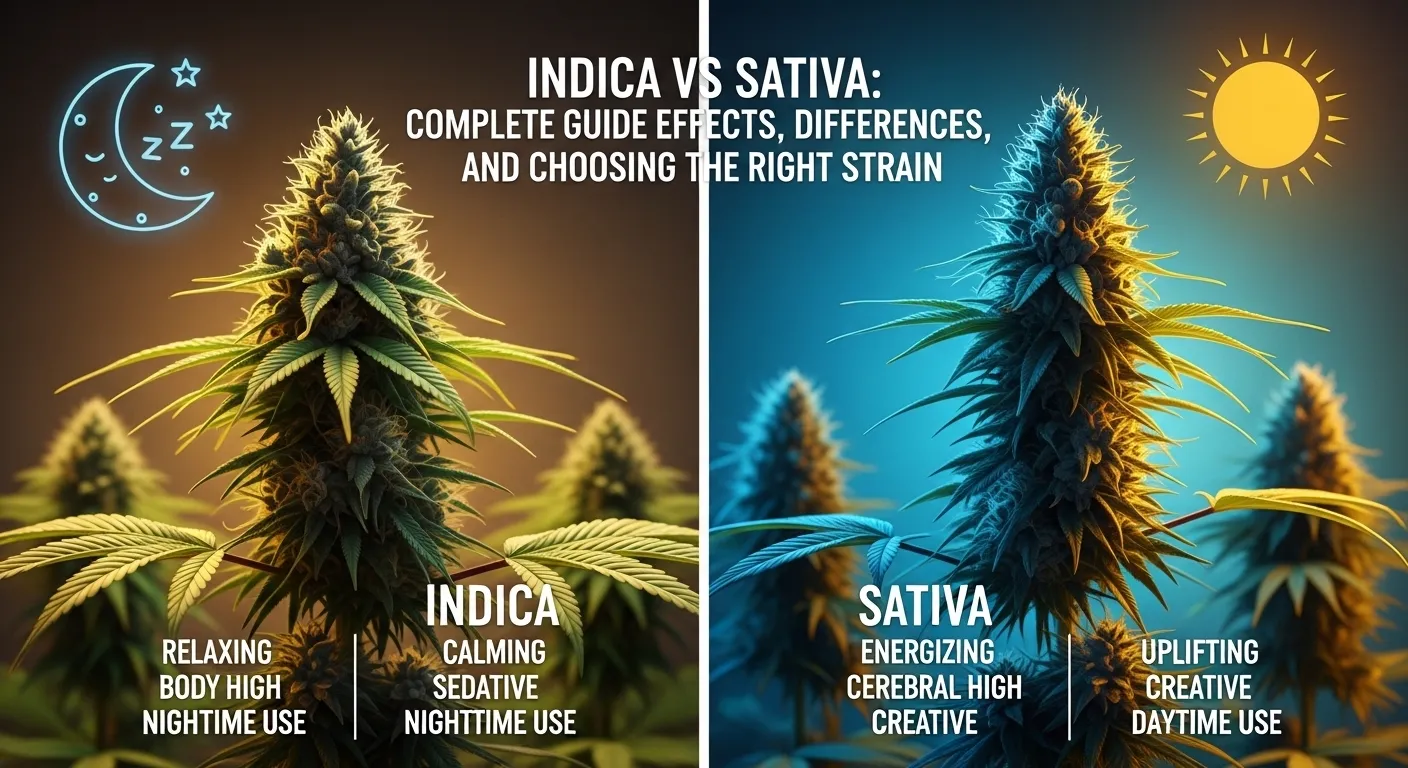
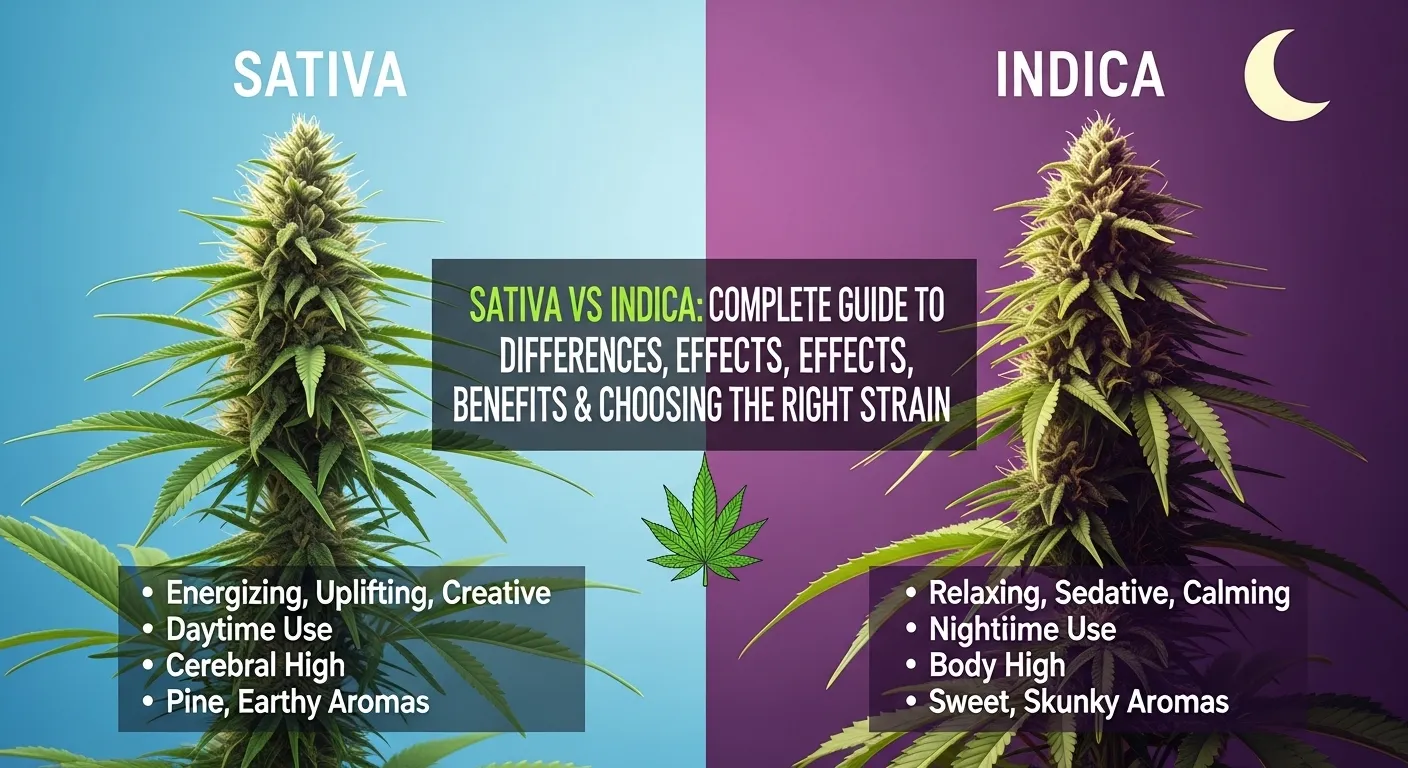

When people first explore cannabis, one of the most common questions they come across is Sativa vs Indica. These two terms are often used to describe different types of cannabis strains, each believed to produce unique effects on the mind and body.
Sativa is usually associated with uplifting, energetic, and creative feelings, while Indica is commonly linked with relaxation, calmness, and a more body-focused experience.
However, the reality is more complex than simple labels. Many beginners assume that Sativa will always energize and Indica will always relax, but modern cannabis science shows that effects depend on multiple factors like cannabinoids, terpenes, dosage, and individual body chemistry.
In this article, we will break down everything you need to know about Sativa and Indica, including their origins, differences, effects, and real-world uses. By the end, you’ll clearly understand how to choose the right strain based on your personal needs and experience.
🌱 Origin and History of Sativa and Indica
The terms Sativa and Indica come from the early botanical classification of the cannabis plant, and they are deeply connected to geography and traditional use. Cannabis Sativa is believed to have originated in warmer equatorial regions such as Southeast Asia, Central America, and parts of Africa. These climates influenced the plant’s tall, thin structure and longer flowering cycle, allowing it to thrive in sunny, humid environments. Historically, Sativa plants were often cultivated for industrial uses like fiber (hemp), seeds, and later for their stimulating effects.
On the other hand, Cannabis Indica is thought to have originated in the harsher, cooler climates of the Hindu Kush mountain range, which spans parts of Afghanistan, Pakistan, and India. Because of these rugged conditions, Indica plants evolved to be shorter, bushier, and more resistant to cold. Traditional communities in these regions used Indica strains for relaxation, pain relief, and spiritual or medicinal purposes.
Over time, cannabis spread globally through trade and cultural exchange. As cultivation expanded, breeders began crossing different plants, leading to modern hybrid strains. Today, most cannabis available in the market is not purely Sativa or Indica but a combination of both, making traditional classifications more of a general guideline than a strict rule.
🌿 Botanical Differences Between Sativa and Indica
One of the easiest ways to understand the Sativa vs Indica distinction is by looking at their physical and botanical characteristics. Although both belong to the same Cannabis genus, they grow in noticeably different ways due to their adaptation to distinct environments.
Cannabis Sativa plants are typically tall and slender, often reaching heights of up to 6–12 feet or more when grown outdoors. They have long, narrow leaves and require a warmer climate with plenty of sunlight to fully develop. Sativa plants also take longer to flower compared to Indica, sometimes needing up to 10–16 weeks before harvest. This longer growth cycle allows them to produce larger yields in ideal conditions.
In contrast, Cannabis Indica plants are much shorter and bushier, usually growing between 3–6 feet tall. Their leaves are broader and darker green, helping them absorb sunlight efficiently in mountainous or cooler environments. Indica strains generally have a faster flowering time, often ready for harvest in 6–9 weeks, making them popular among growers who prefer quicker cultivation cycles.
These structural differences are not just visual—they also influence how each plant develops cannabinoids and terpenes. While appearance alone does not determine effects, it has traditionally helped growers and users distinguish between Sativa and Indica strains before laboratory testing became common.
⚗️ Chemical Composition: THC, CBD and Cannabinoids
To truly understand the Sativa vs Indica comparison, it is important to look beyond plant appearance and focus on what actually drives effects: chemical compounds called cannabinoids. The two most well-known cannabinoids are THC (tetrahydrocannabinol) and CBD (cannabidiol), but there are many others that also influence the experience.
THC is the primary psychoactive compound in cannabis, responsible for the “high” feeling. Higher THC levels are often associated with stronger mental and physical effects. CBD, on the other hand, is non-intoxicating and is commonly linked with calming, anti-anxiety, and anti-inflammatory properties. However, it does not produce a high like THC.
Traditionally, people believed that Sativa strains contained more THC and produced more energizing effects, while Indica strains had higher CBD levels and caused relaxation. In reality, modern research shows this is not always accurate. Both Sativa and Indica strains can have high or low levels of THC and CBD depending on how they are bred.
What matters more today is the overall cannabinoid profile rather than the strain label. Two strains labeled as “Indica” may feel completely different because of varying chemical compositions. This is why modern cannabis users and researchers emphasize testing and lab results instead of relying only on Sativa or Indica classification.
Ultimately, cannabinoids work together in what is known as the “entourage effect,” meaning the full combination of compounds determines the final experience.
🌸 Terpenes: The Hidden Factor Behind Effects
While cannabinoids like THC and CBD get most of the attention, another crucial factor in the Sativa vs Indica experience is terpenes. Terpenes are natural aromatic compounds found in cannabis and many other plants such as lavender, citrus fruits, and pine trees. They are responsible for the distinct smell and flavor of each strain, but they also play a major role in shaping how cannabis feels.
For example, myrcene is a terpene commonly associated with earthy aromas and is often linked to calming, sedative-like effects. Strains with higher myrcene content are more likely to feel relaxing and are often found in Indica-dominant varieties. Limonene, on the other hand, has a citrus scent and is often connected with uplifting, mood-enhancing effects, which are more commonly associated with Sativa strains. Another important terpene, pinene, is believed to support alertness and focus.
What makes terpenes especially important is that they interact with cannabinoids to create what is known as the entourage effect. This means the overall experience is not determined by THC or CBD alone, but by how all compounds work together.
Because of this, two cannabis strains with the same THC level can feel completely different depending on their terpene profiles. This is one of the main reasons why the traditional Sativa vs Indica labels do not always guarantee consistent effects in real-world use.
⚡ Effects of Sativa on Mind and Body
Sativa strains are commonly associated with uplifting and energizing effects, making them a popular choice for daytime use. Many users report that Sativa tends to produce a more “head-focused” experience, influencing thoughts, creativity, and mental clarity rather than heavy physical relaxation.
On the mental side, Sativa is often linked with increased alertness, improved focus, and enhanced creativity. This is why some people prefer it for activities that require brainstorming, artistic work, social interaction, or staying productive during the day. It can create a sense of motivation and mental stimulation, which may help users feel more engaged and active.
Physically, Sativa strains are generally described as less sedating compared to Indica. Instead of causing strong body heaviness or sleepiness, they may produce a lighter, more energetic sensation. However, the intensity of these effects can vary widely depending on THC levels and individual tolerance.
Sativa is often chosen for daytime situations such as outdoor activities, social gatherings, or creative tasks. However, it is important to note that high-THC Sativa strains may sometimes cause anxiety or restlessness in sensitive individuals, especially at higher doses.
Overall, Sativa is best understood as a strain type that typically promotes mental stimulation and energy, but the actual experience depends on multiple factors including dosage, chemistry, and personal body response.
💤 Effects of Indica on Mind and Body
Indica strains are widely known for their calming and deeply relaxing effects, making them a preferred choice for evening or nighttime use. Compared to Sativa, Indica is often described as producing a more “body-focused” experience, helping users feel physically relaxed and mentally at ease.
On the mental level, Indica is commonly associated with stress relief, quieting of racing thoughts, and a sense of emotional calm. Many users report feeling more grounded and less mentally active, which can be helpful after a long or stressful day. Because of this soothing effect, Indica strains are often chosen by people looking to unwind or disconnect from daily pressure.
Physically, Indica is best known for its “body high.” This may include muscle relaxation, a heavy or warm sensation in the body, and in many cases, increased sleepiness. These properties make Indica strains popular among individuals who struggle with insomnia or have difficulty relaxing physically.
Indica is often used in nighttime routines, such as before sleep, meditation, or rest. It may also be preferred by people seeking relief from physical discomfort or tension.
However, it is important to remember that not all Indica strains produce the same level of sedation. The effects can vary depending on THC content, terpene profile, and individual tolerance. While Indica is generally relaxing, some users may experience milder or more balanced effects depending on the strain composition.
Overall, Indica is best understood as a strain type that supports relaxation, calmness, and rest, especially when used in appropriate settings and dosages.
⚖️ Sativa vs Indica: Myths vs Scientific Reality
For many years, the cannabis world has been shaped by a simple belief: Sativa equals energy and Indica equals relaxation. While this idea is widely used, modern research and real-world experience show that the truth is more complex. The traditional Sativa vs Indica classification is often more of a marketing label than a strict scientific rule.
One major myth is that Sativa strains always produce an uplifting and creative high. In reality, some high-THC Sativa strains can actually cause anxiety, overthinking, or restlessness in certain users. Similarly, Indica strains are not guaranteed to cause sleep or deep relaxation; some may feel only mildly calming depending on their chemical profile.
Another misconception is that Sativa and Indica are completely different chemical plants. Scientifically, both belong to the same Cannabis species, and their effects depend far more on cannabinoids and terpenes than on plant shape or strain name.
Modern cannabis science suggests that the idea of Sativa vs Indica is overly simplified. Today, most strains are hybrids, meaning they contain genetic traits from both types. Because of this, two strains labeled the same way can produce very different experiences.
In conclusion, while Sativa and Indica labels can be useful as general guides, they should not be treated as absolute rules. A more accurate way to understand cannabis effects is by looking at lab-tested cannabinoid levels and terpene profiles rather than relying only on traditional categories.
🌿 Hybrid Strains Explained: The Modern Cannabis Standard
In today’s cannabis world, most products are not purely Sativa or Indica. Instead, they are hybrid strains, created by crossbreeding different cannabis plants to combine desirable traits from both categories. This modern approach has become the standard in cultivation because it allows growers to fine-tune effects, potency, and growth characteristics.
A hybrid strain can lean toward either Sativa or Indica dominance, or it can be a balanced mix of both. For example, a Sativa-dominant hybrid may still provide uplifting and energetic effects but with a smoother, more controlled experience due to Indica genetics. On the other hand, an Indica-dominant hybrid may offer deep relaxation with a slightly lighter mental effect compared to pure Indica strains.
Balanced hybrids aim to deliver a combination of both worlds—mental stimulation along with physical relaxation. This makes them popular among users who want flexibility without extreme effects in either direction.
Hybrids are also important in medical cannabis because they allow more precise targeting of symptoms such as pain, anxiety, or insomnia. By adjusting the genetic balance, breeders can create strains tailored to specific therapeutic needs.
Because of extensive hybridization, many experts now argue that the traditional Sativa vs Indica classification is less important than it once was. Instead, the focus has shifted toward cannabinoid content, terpene profiles, and individual response. This reflects a more accurate understanding of how cannabis truly works in the body and mind today.
🏥 Medical Uses of Sativa, Indica and Hybrids
Cannabis is widely studied and used for a variety of medical and wellness purposes, and both Sativa, Indica, and hybrid strains may offer different types of support depending on their chemical composition and how individuals respond.
Sativa strains are often chosen for conditions related to mood and mental energy. Some users report that Sativa may help with symptoms of depression, fatigue, and lack of focus due to its uplifting and stimulating effects. However, in people prone to anxiety, high-THC Sativa strains may sometimes increase restlessness or nervous thoughts.
Indica strains, on the other hand, are commonly associated with physical relaxation and calming effects. They are frequently used by individuals dealing with chronic pain, muscle tension, insomnia, and stress-related conditions. Because Indica can produce a sedative-like effect, it is often preferred in nighttime wellness routines.
Hybrid strains are especially important in medical cannabis because they allow a more balanced approach. Depending on their genetic mix, hybrids can be designed to target multiple symptoms at once, such as combining pain relief with mild mental clarity or reducing anxiety while avoiding heavy sedation.
It is important to understand that cannabis is not a one-size-fits-all treatment. The effects vary greatly depending on dosage, cannabinoid levels, terpene profile, and individual body chemistry. For this reason, many medical users rely on trial, guidance, and regulated products to find what works best for their specific condition and needs.
🧘 Psychological and Emotional Effects
Beyond physical sensations, cannabis strains can also influence mood, emotions, and mental state, which is an important part of the Sativa vs Indica experience. While these effects are not identical for everyone, there are general patterns that many users report.
Sativa strains are often linked with a more active mental state. Some users experience increased talkativeness, excitement, and a sense of positivity or motivation. This can sometimes enhance social interaction or creative thinking. However, in certain individuals—especially those sensitive to THC—Sativa may also lead to overthinking, anxiety, or mental overstimulation, particularly in high doses or stressful environments.
Indica strains are more commonly associated with emotional calmness and mental quieting. Users often describe a sense of emotional release, reduced stress, and a slower flow of thoughts. This can be helpful for people dealing with stress, irritability, or emotional fatigue, as it may promote a more grounded and peaceful mindset. In some cases, Indica can also lead to drowsiness or a “detached” feeling, especially in stronger strains.
It is important to note that emotional effects are highly individual and influenced by factors such as personality, tolerance, setting, and prior experience. The same strain may feel uplifting to one person and calming to another.
Overall, cannabis does not affect everyone in a predictable way. Instead, psychological responses depend on a combination of chemistry, environment, and personal mental state, making individual experience a key factor in understanding its emotional impact.
🧪 Factors That Influence Your Cannabis Experience
The experience of Sativa vs Indica is not determined by strain name alone. In reality, several important factors work together to shape how cannabis affects your mind and body. Understanding these variables helps explain why the same strain can feel completely different for different people.
One of the most important factors is THC level. Higher THC generally leads to stronger psychoactive effects, but it does not always mean better or more enjoyable results. For some users, high THC can feel overwhelming, especially if they are inexperienced or sensitive.
Another key factor is the CBD content. CBD can balance the effects of THC by reducing anxiety and promoting a calmer experience. Strains with a higher CBD ratio often feel smoother and less intense.
The terpene profile also plays a major role. Terpenes influence aroma and can subtly shape effects such as relaxation, focus, or mood elevation. This is why two strains with similar THC levels can feel very different.
Additionally, the method of consumption matters. Smoking, vaping, edibles, and oils all affect how quickly and strongly cannabis impacts the body. For example, edibles take longer to activate but often produce longer-lasting effects.
Finally, individual factors like body chemistry, tolerance, mood, and environment strongly influence the overall experience. Stressful settings may intensify anxiety, while a comfortable environment can enhance relaxation.
Together, these factors show that cannabis effects are complex and highly personal, making experimentation and awareness essential for understanding your ideal experience.
🧭 How to Choose Between Sativa and Indica
Choosing between Sativa and Indica depends largely on your personal goals, lifestyle, and how your body responds to cannabis. While traditional labels can offer a general guideline, the best choice is always based on the type of experience you are looking for rather than the name alone.
If you are looking for a more active and productive daytime experience, Sativa is often preferred. It may support focus, creativity, and social interaction, making it suitable for morning or afternoon use. Many people choose Sativa when they want to stay engaged, complete tasks, or enjoy outdoor activities.
On the other hand, if your goal is relaxation, stress relief, or sleep support, Indica is usually the better option. It is commonly used in the evening or before bed because of its calming and body-focused effects. Indica can help you unwind after a long day and promote a sense of physical comfort.
For beginners, it is often recommended to start with low doses regardless of strain type. This allows you to observe how your body reacts before increasing intake. Over time, you can better understand which type suits your needs.
It is also important to consider that modern cannabis is often hybrid-based, meaning effects may not strictly follow Sativa or Indica labels. Reading product information, checking cannabinoid levels, and understanding terpene profiles can provide more accurate guidance.
Ultimately, the best choice comes from personal experience, mindful use, and paying attention to how different strains affect your mind and body.
📊 Sativa vs Indica Comparison: Quick Overview Table
To make the Sativa vs Indica differences easier to understand, here is a simple comparison based on their most commonly reported characteristics. While modern cannabis is often hybridized, this table still helps provide a general reference point for beginners.
| Feature | Sativa | Indica |
| Plant Structure | Tall, thin, airy leaves | Short, bushy, dense leaves |
| Growth Time | Longer flowering period | Shorter flowering period |
| Climate Preference | Warm, sunny climates | Cooler, mountainous regions |
| Typical Mental Effect | Uplifting, energetic | Calming, soothing |
| Physical Effect | Light, less sedating | Heavy, relaxing |
| Best Time of Use | Daytime | Nighttime |
| Common Use Case | Creativity, focus, socializing | Sleep, relaxation, stress relief |
| User Sensation | “Head high” | “Body high” |
It is important to remember that this table represents general trends rather than strict rules. In modern cannabis cultivation, most strains are hybrids, meaning their effects may not fully match traditional expectations.
Additionally, factors such as THC level, CBD ratio, and terpene profile often have a stronger influence on the experience than whether a strain is labeled Sativa or Indica. This is why two products with the same classification can still feel very different.
Use this comparison as a starting point, but always focus on personal experience and product details for more accurate results.
❗ Common Myths About Sativa and Indica
Despite growing scientific understanding, many myths about Sativa vs Indica still exist and often confuse new users. These misconceptions are usually based on outdated information or oversimplified marketing labels rather than real chemical differences.
One of the most common myths is that Sativa always gives an energetic high. While Sativa strains are often associated with uplifting effects, not all of them produce stimulation. Some can feel quite balanced or even mildly sedating depending on their THC levels and terpene profiles.
Another widespread belief is that Indica always makes you sleepy. In reality, Indica strains are known for relaxation, but not every Indica will cause deep sleep. Some may simply reduce stress or create a calm, comfortable feeling without strong sedation.
Many people also think that Sativa and Indica are completely different species with unique effects. Scientifically, both belong to the same Cannabis plant species, and their differences are not absolute. Most modern strains are hybrids, meaning their effects come from a mix of genetics.
A further misconception is that strain name alone guarantees the experience. In truth, effects depend more on chemical composition, including cannabinoids like THC and CBD, as well as terpenes and individual body response.
Overall, these myths show why relying only on Sativa or Indica labels can be misleading. A more accurate understanding comes from looking at lab-tested data and personal experience rather than assumptions or traditional stereotypes.
🌍 Legal and Safety Considerations
When discussing Sativa vs Indica, it is also important to understand the legal and safety aspects of cannabis use. Laws related to cannabis vary widely from country to country and even within different regions of the same country. In some places, cannabis is fully legal for medical and recreational use, while in others it remains strictly prohibited. Therefore, it is essential to always be aware of local regulations before considering use or purchase.
From a safety perspective, responsible use is a key factor in having a positive experience. Cannabis affects every individual differently, and overconsumption—especially of high-THC products—can lead to unwanted effects such as dizziness, anxiety, paranoia, or impaired coordination. This is why beginners are often advised to start with low doses and slow consumption to better understand their tolerance.
Another important consideration is product quality. In regulated markets, cannabis is often lab-tested for potency and purity, ensuring safer consumption. However, in unregulated markets, there may be risks of contamination or inaccurate labeling, which can increase health concerns.
It is also important to avoid mixing cannabis with alcohol or other substances, as this can intensify effects unpredictably. Additionally, individuals with certain medical conditions or those taking medication should consult healthcare guidance before use.
Ultimately, safe cannabis use is about awareness, moderation, and informed decision-making. Understanding both legal boundaries and personal limits ensures a more controlled and responsible experience, regardless of whether someone chooses Sativa, Indica, or hybrid strains.
❓ (FAQs)
🌿 Is Sativa stronger than Indica?
Not necessarily. The strength of cannabis depends on THC content, terpene profile, and individual tolerance, not just whether it is labeled Sativa or Indica. Some Indica strains can be stronger than Sativa strains and vice versa.
💤 Which is better for sleep, Sativa or Indica?
Generally, Indica strains are more commonly associated with sleep support because of their calming and body-relaxing effects. However, high-THC Sativa strains may sometimes make it harder to sleep for certain users.
🧠 Which is better for anxiety?
This varies by person. Some people find Indica calming for anxiety, while others prefer balanced hybrids or CBD-rich strains. High-THC Sativa strains may increase anxiety in sensitive individuals.
⚖️ Can you mix Sativa and Indica?
Yes. In fact, many modern cannabis products are already hybrids, meaning they naturally combine both Sativa and Indica genetics to create balanced effects.
🌱 Do Sativa and Indica affect everyone the same way?
No. Effects vary widely based on body chemistry, dosage, tolerance, environment, and mindset. Two people can have completely different experiences with the same strain.
🔬 Are Sativa and Indica real scientific categories?
They are traditional classifications based on plant appearance and origin, but modern science shows that chemical composition is more important than strain label.
🧪 What is the safest way to choose a strain?
Start with low THC levels, understand product information, and observe your body’s response before increasing dosage.
If you want next, I can write the final conclusion + SEO summary + meta title + keyword optimization section to complete your blog.
🏁 Conclusion:
The comparison between Sativa vs Indica has helped cannabis users for decades, but Modern understanding shows that it is more of a general guideline than a strict rule. While Sativa is commonly associated with uplifting and energizing effects, and Indica with relaxation and calmness, the real experience depends on many deeper factors.
Today, we know that the effects of cannabis are influenced more by cannabinoids like THC and CBD, terpene profiles, dosage, and individual body chemistry than by strain names alone. This is why two products labeled the same way can feel completely different from person to person.
Sativa may be helpful for daytime focus, creativity, and social activities, while Indica is often preferred for evening relaxation, stress relief, and sleep support. However, modern hybrid strains have made these categories less distinct, offering balanced effects that combine the best of both worlds.
The most important takeaway is that cannabis is highly personal and variable. There is no universal “best strain”—only what works best for your own body, tolerance, and goals. Understanding how you respond to different products is far more valuable than relying only on labels.
In the end, the smartest approach is to stay informed, start with moderation, and pay attention to how different strains affect you. This way, you can make safer, more effective choices and get a clearer understanding of what truly works for your needs.